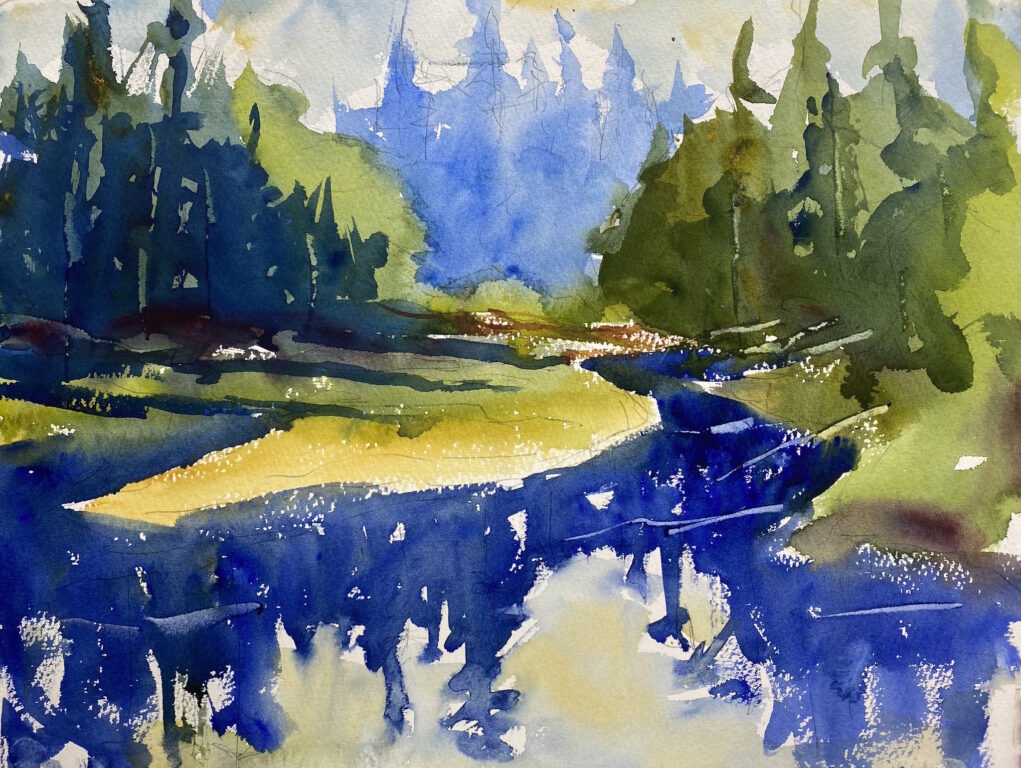
Over the last couple of weeks, I’ve made a number of plein air paintings and I’d like to share some of them with you. The painting above was made at the mouth of Curley Creek near Port Orchard. I stood on the bridge while painting it and several people stopped briefly to see what I was doing. I like the strong colors and the bold brush strokes with the flecks of white.
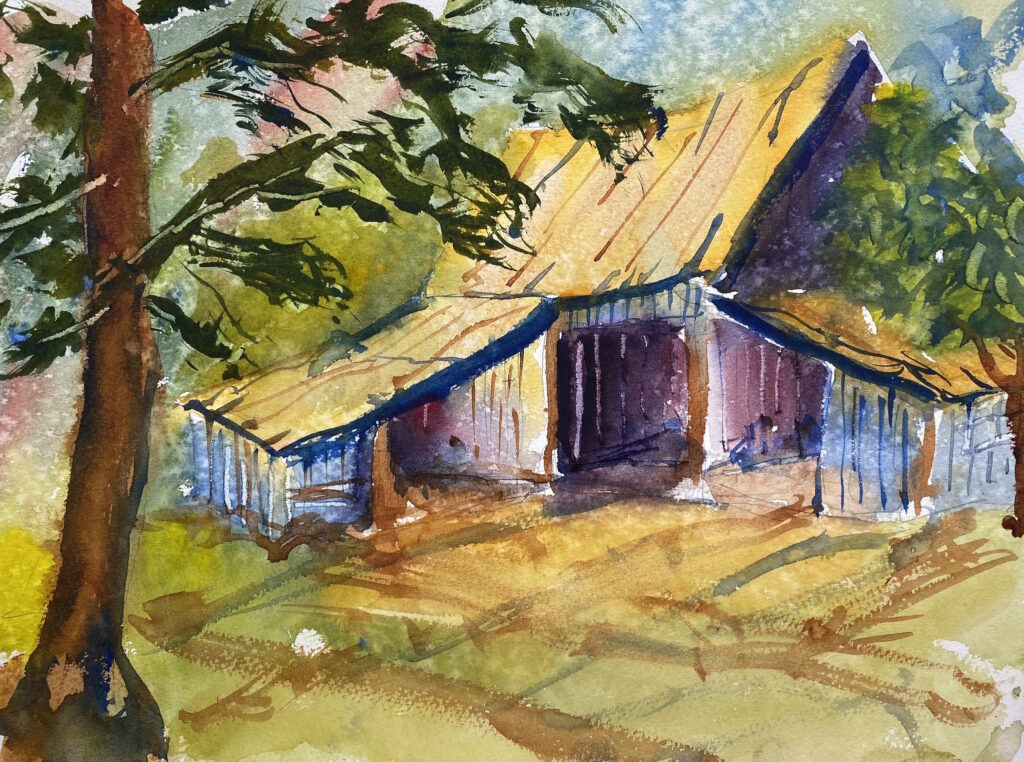
Bainbridge Island sheds
My son, Guy, and I joined other painters from Poulsbo Artist League to paint at a farmhouse on Bainbridge Island. I like the shapes of this cluster of sheds, but it started raining as I painted. You can see the raindrops on the background. I retreated to a shed and finished the painting.
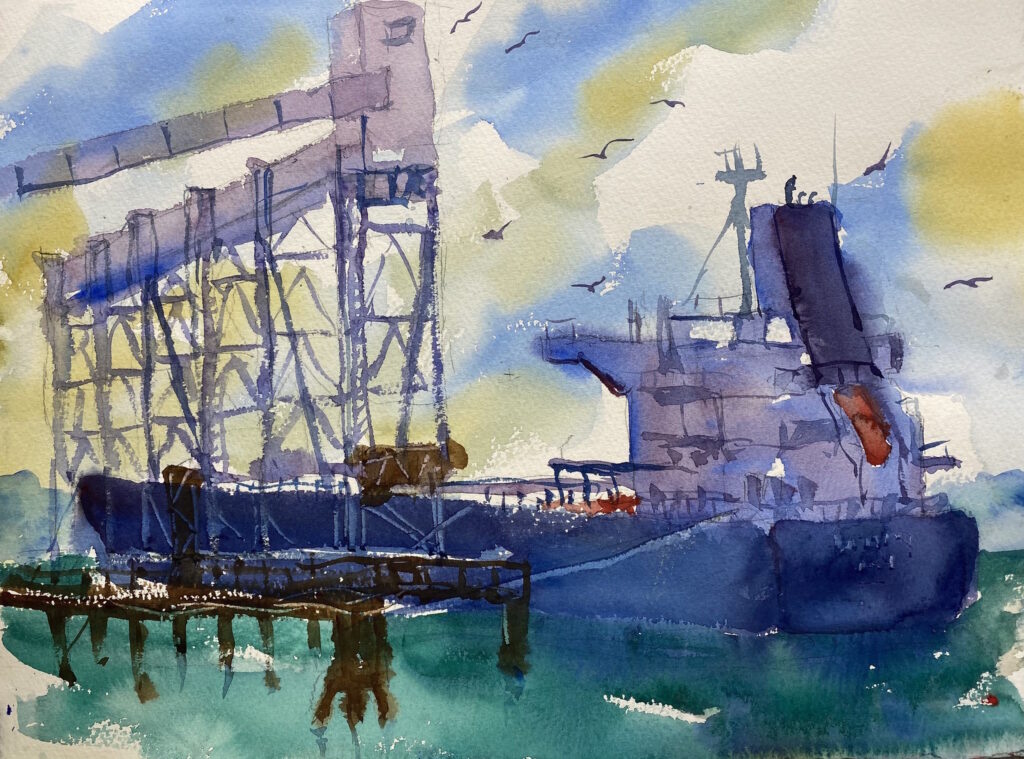
Grain Ship seen from Centennial Park in Seattle
I traveled to Seattle to paint with other members of the Northwest Watercolor Society at Centennial Park. I tackled this huge ship loading grain at the grain elevator on the Seattle waterfront. The proportions of the boat and the elevator were challenging, but I think I got them basically right.
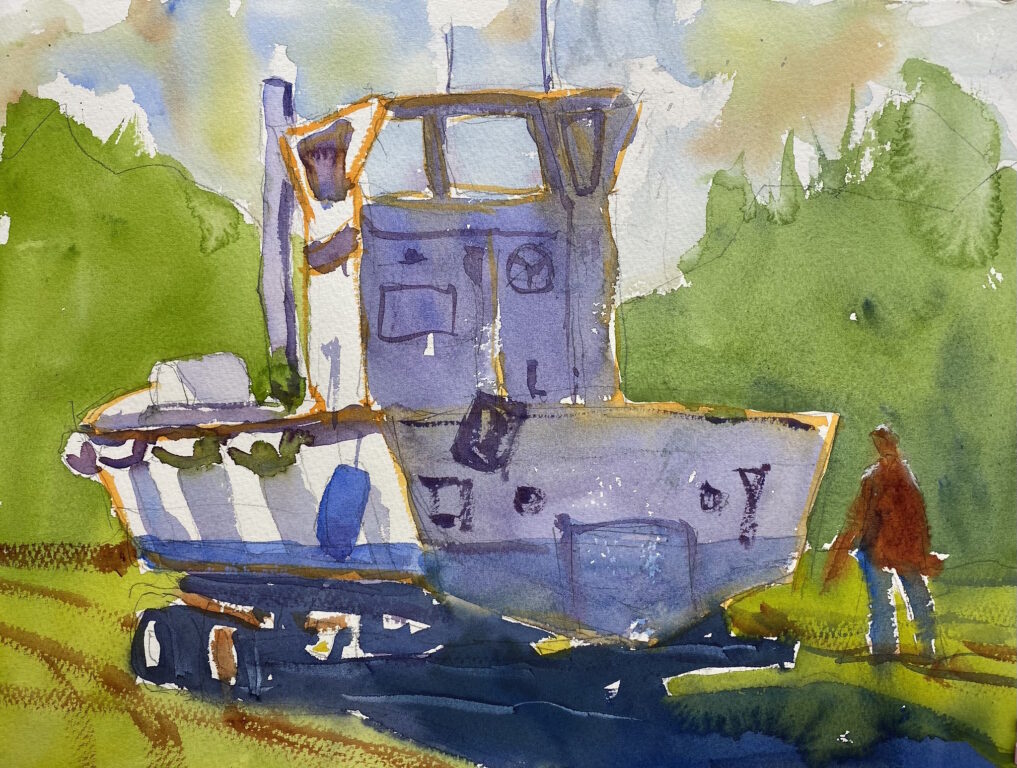
Boat on a trailer along the Seattle ship canal
I found this boat on a trailer as I snooped along the Seattle ship canal. I liked the shape of it, so I took a photo and painted it in the studio when I got home.
La Conner harbor
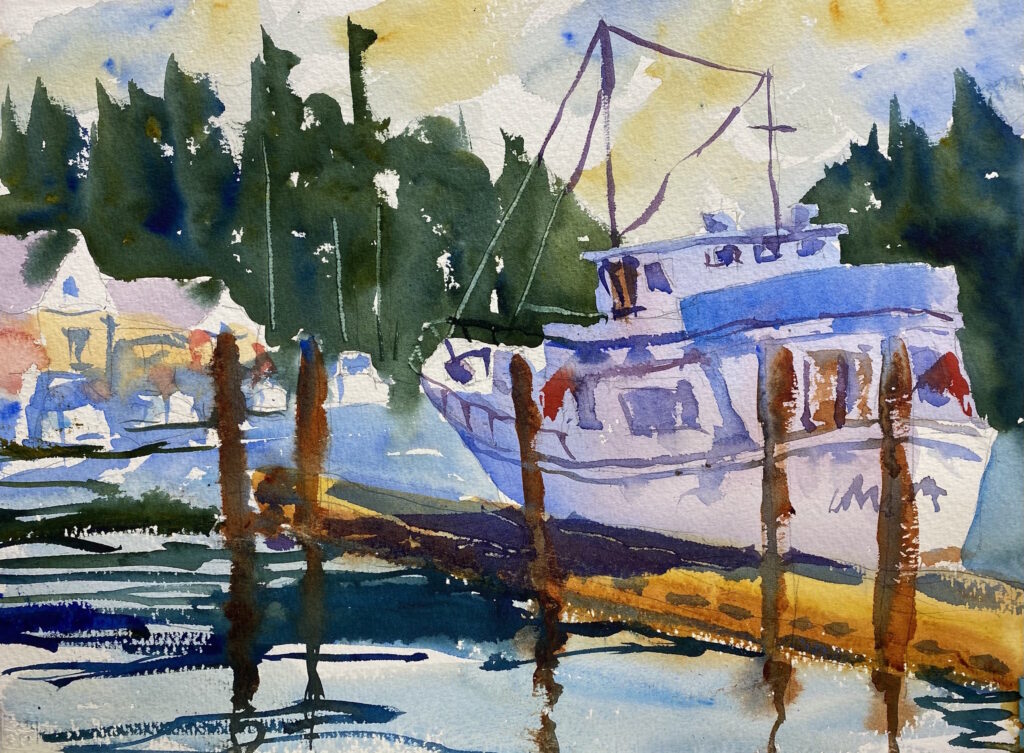
I traveled to La Conner, WA, to see the fabled waterfront and I wasn’t disappointed. The La Conner harbor is a favorite of artists and photographers because of the many boats tied up along the channel that goes by the historic downtown, and for the charming boardwalk in front of the many cafes and restaurants that line the docks. I made this painting in the evening as the sun slanted low across the harbor.
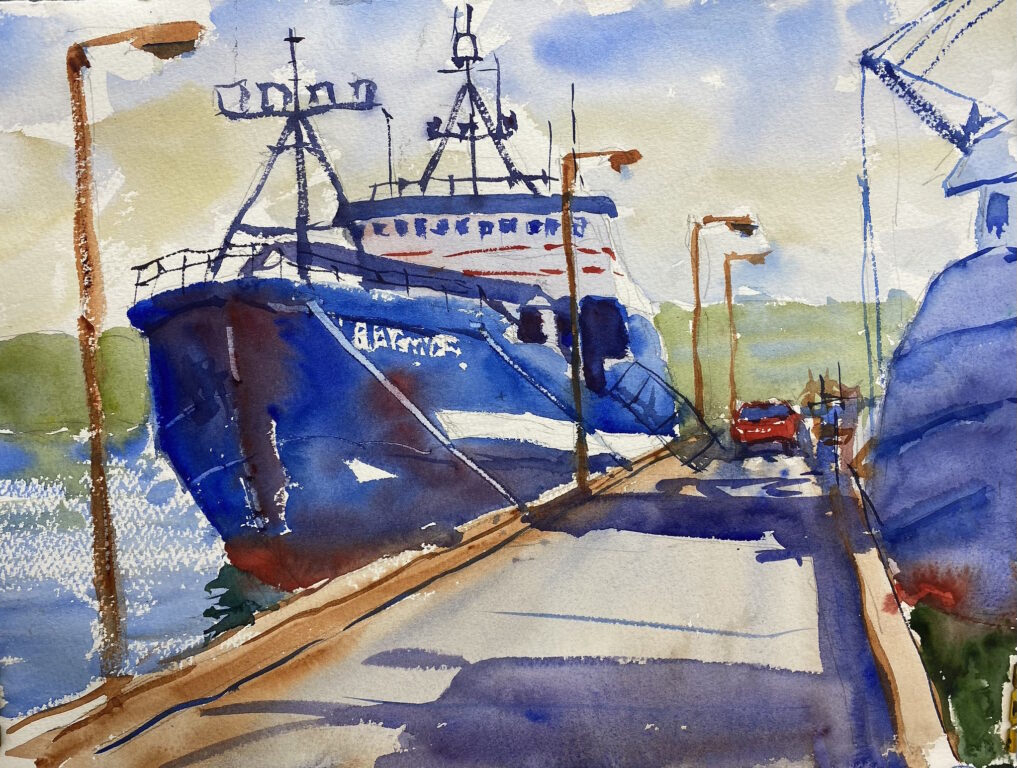
The fishing vessel Baranof at Fishermen’s Terminal in Seattle
Last Wednesday I took the 7:20 am ferry to Seattle so that I could paint with members of Northwest Watercolor Society (NWWS). This group meets at paint-worthy locations every Wednesday to paint together and share their work.
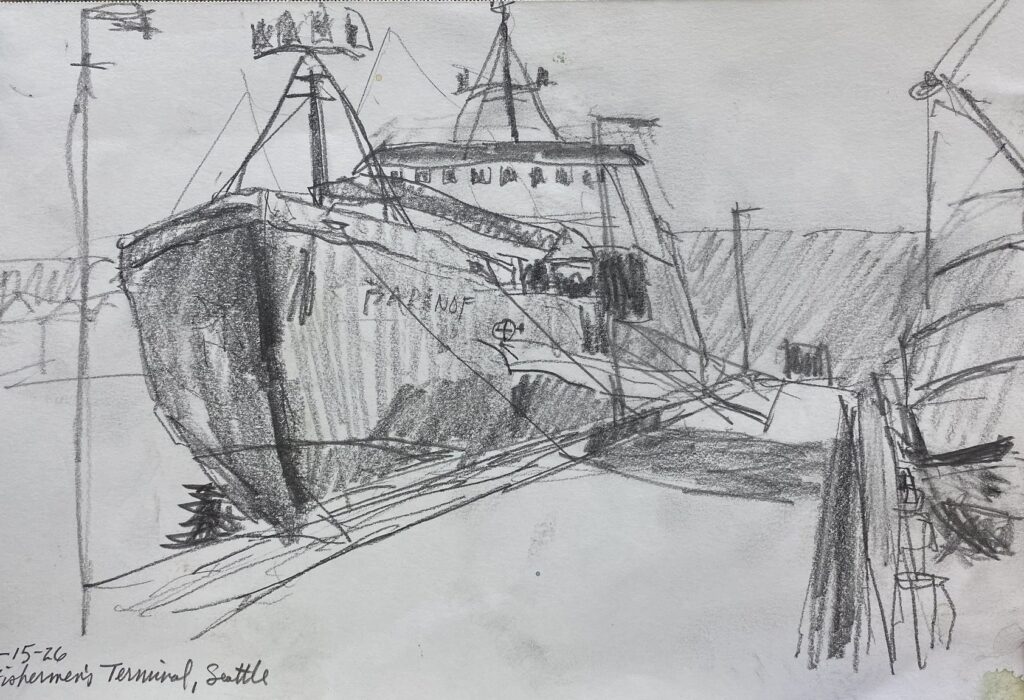
I arrived in Seattle at 8:20 and drove to Fishermen’s Terminal to get in a painting early in the morning. I strolled the docks and found a row of big fishing boats, including the F/V Baranof. There was a big shadow from another boat, so I set up my easel and made a pencil sketch in my small (5 by 8) sketchbook. I always make a pencil sketch first so that I can get the composition right and establish the values of the painting.
My pencil sketch of the Baranof
In this case, the dock naturally led the eye toward the boat, and later on a red pickup truck conveniently drove up and parked next to the boat. Nice subject! After I drew the shapes of the boats and the dock, I used the flat of the pencil to show how dark each shape was. The shaded side of the boat was very dark, and the light side of the boat was very light. Then I filled in the other values: somewhat dark, medium, and somewhat light.
Next I drew the composition on my watercolor paper and paused. The moment before picking up the brush is always a scary moment for me. What if I ruin it? What if I don’t know what I’m doing?
But I chase those thoughts away and make my first brush stroke. From then on, I’m in the zone. The painting unfolds as I go, and time seems to disappear as the painting overtakes me. I paint the boat hull, the opposite boat in shadow, the docks and the light poles. Then on to the surrounding shapes, finishing up with the rigging, the water, and the sky.
I was pretty happy with this painting. I think the mass of the boat attracts the eye and provides a good shape for the rest of the painting to relate to.
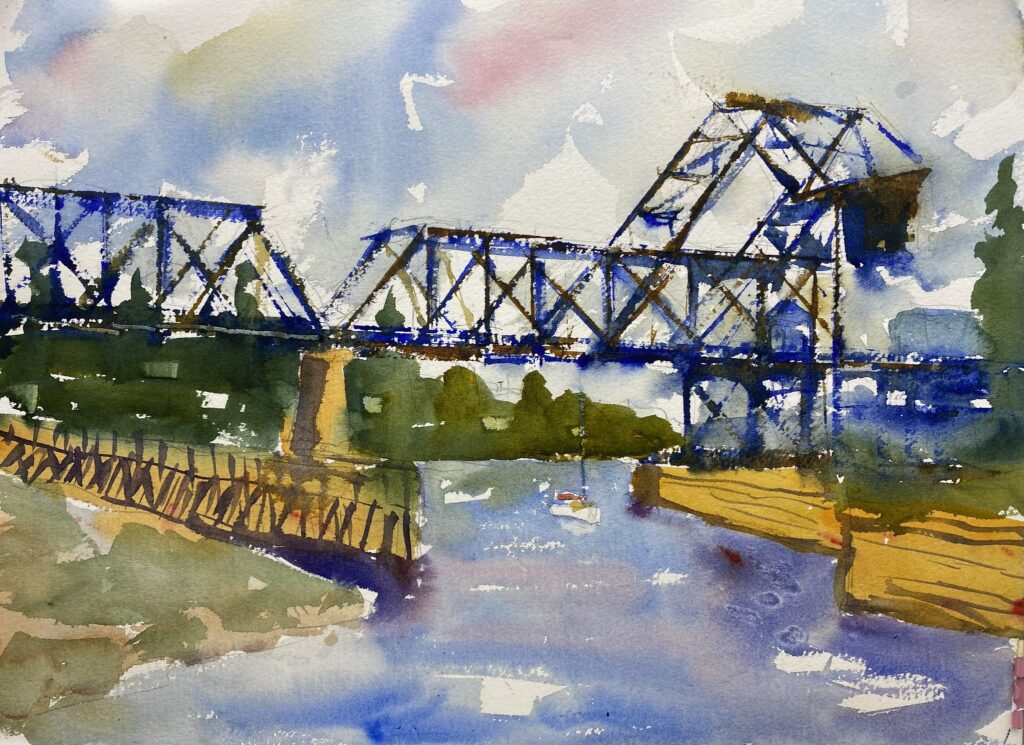
Railroad bridge over the ship canal in Seattle.
Then I packed up my gear and drove to Commodore Park, where NWWS members were gathering. Commodore Park is located alongside the Seattle Ship Canal, which provides a waterway from Elliot Bay (the ocean) to the fresh water of Lake Washington. Locks are provided so that boats can be raised or lowered to transit the canal.
It’s a beautiful location with lots of activity. Docktenders guide the boats that are entering or leaving the lock, and Seattleites of all descriptions are milling around the locks. Birds flit about, raccoons scurry on the shore, and an occasional seal can be seen in the water.
I scoped out the park and found a location alongside Diane, who had already started. I chose to paint the rusty old railroad bridge over the canal. I used an old credit card to paint the girders of the bridge. First I mixed up a good amount of paint in my palette, then I rubbed the edge of the credit card in the paint and applied it to the paper. The marks it makes are just right for girders and cranes.
After that, I painted the rest of the painting with the brush. I felt pretty good about this painting. Afterward, I joined about twenty other NWWS painters for the “throwdown”. We all prop up our paintings against a wall so that we can see what everyone has painted. Not only is it fun to see what other painters have done, it’s a great way to learn about other styles and perspectives. I enjoy rubbing elbows with the artists and I try to make contact with as many people as I can.
I drove to the ferry and napped in my car while waiting. It was a good day of painting.
Watch, paint, review. Watch, paint, review. That was my week last week. I spent four days in Long Beach, WA, at a watercolor painting workshop by Eric Wiegardt.
The thing I enjoyed most was the camaraderie among the students in the workshop. I already knew Eric and eight of the seventeen students, so I felt right at home from the opening hugs. Everyone in the group seemed to fit together, and I enjoyed talking with everyone.
Every morning Eric painted a demonstration watercolor while explaining his technique. Then all seventeen of us students attempted to paint the same subject, bearing in mind all that Eric said. This process was repeated in the afternoon, followed by a critique of one of our paintings by Eric.
What did I learn at this workshop that I didn’t learn at the three previous plein air workshops I have taken with Eric?
Probably the most helpful thing for me was to simply watch how he uses his brush to grab pigment off his palette, mix it, and apply it to the paper. His emphasis on using wet pigment, his mixing of colors with the brush, his generous use of water in the brush, and his sweeping strokes on the paper encouraged me to be more confident in my painting.
“Make your first brushstroke a bold statement,” he said. I tried to follow that advice, and I think it helped.
Eric repeated his three basic goals for a painting: capture the eye at a distance, carry the eye throughout the picture plane, and bring the eye to the area of dominance. He gave us a number of tools to use to bring the eye to the area of dominance: contrast, line, placement, animation, warm colors, hard edges, big shapes, and detail.
Eric paints intuitively. That is, he feels his way through the painting, asking what the painting needs and responding to it. He’ll grab a color and try it on the painting, and if it feels right, he’ll go on. He doesn’t like to “go backward,” by scrubbing out a bad place or wiping out an awkward color. He prefers to move forward in the painting.
If the painting has clear values and good interlocking shapes, then it will hold up well. You can use almost any color as long as you have good shapes and values.
He encouraged us to take risks. “If you’re not painting on the edge of your ability,” he said, “You’re not growing as an artist.”
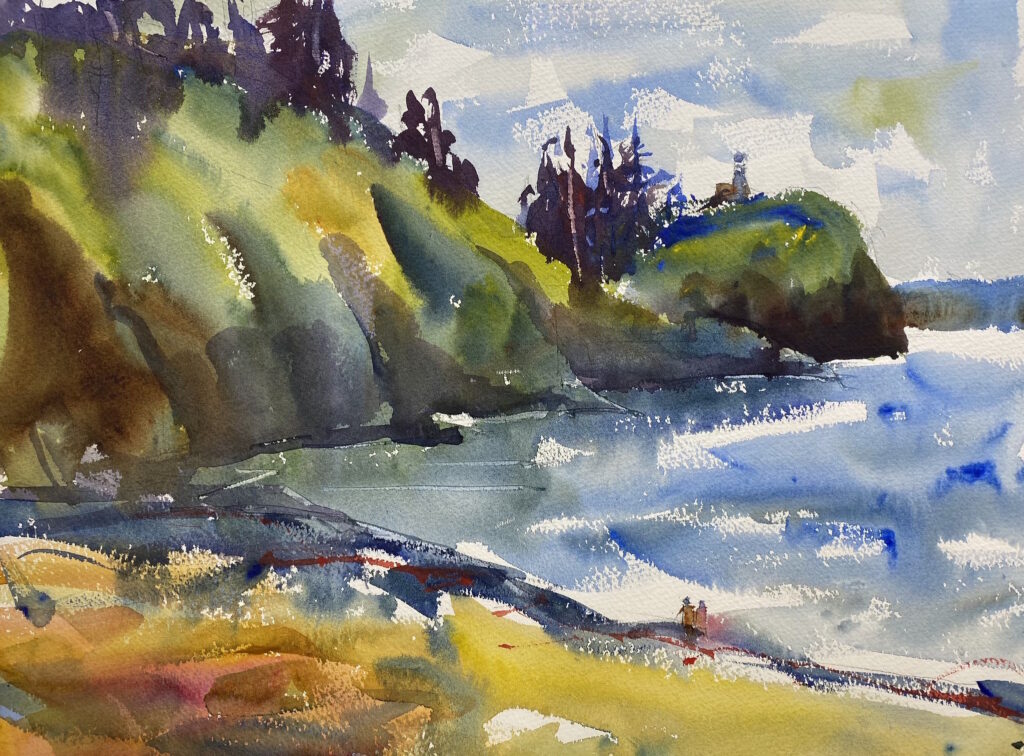
On the first day, we painted the lighthouse at Cape Disappointment. (See my painting above) This is probably the most iconic subject in the Long Beach area, and I’ve painted it several times. This time, watching Eric, I was able to paint more boldly and decisively. I like the results, although my colors got a little dark in places.
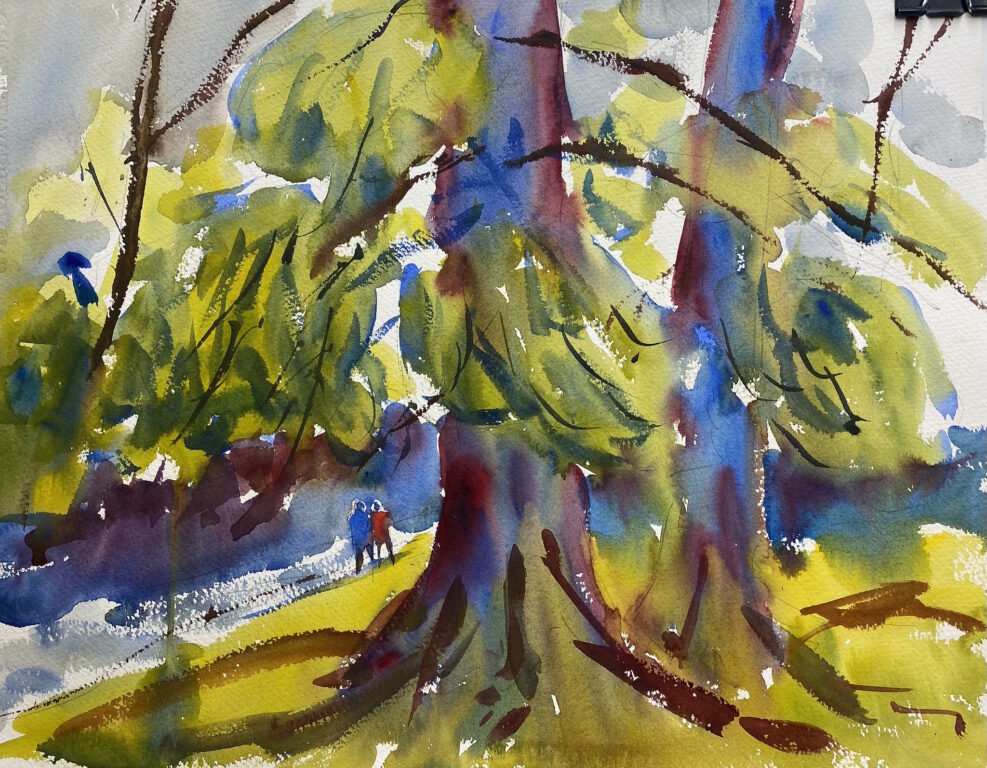
Spruce trees at Oysterville school
On the second day, we painted near the historic Oysterville school. Eric chose as his subject two big spruce trees with their cascading foliage. He added two figures walking on the road next to the trees.
I was pretty happy with my trees. I used a lot of vivid color in the trunks and managed to show the foliage adequately.
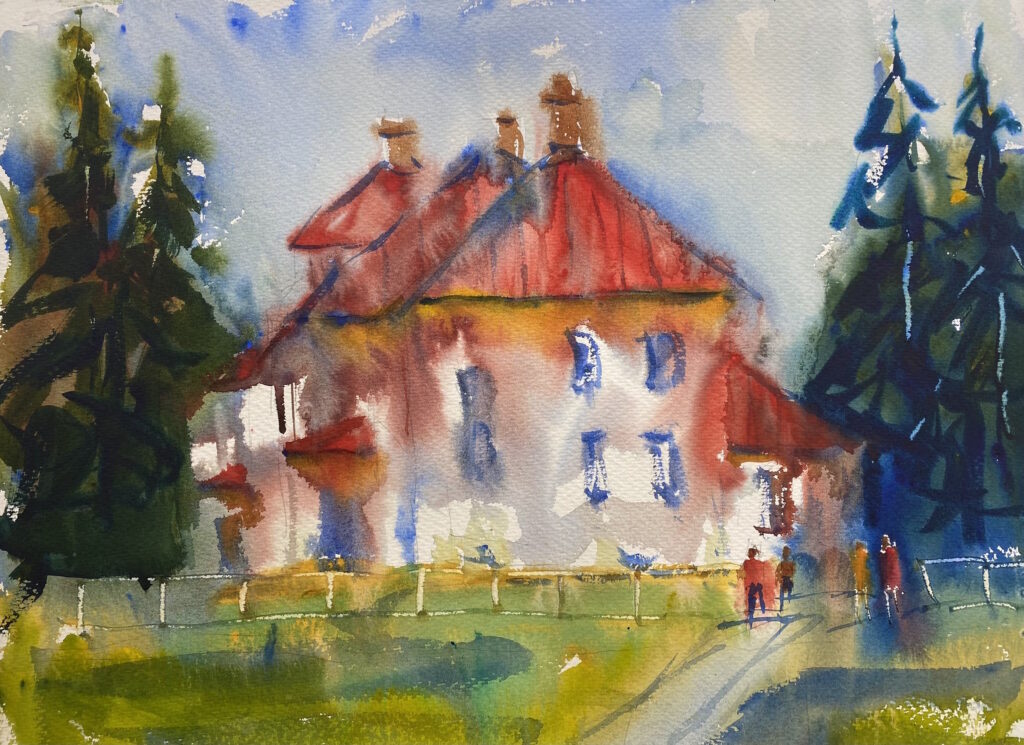
The lighthouse keeper’s house at North Head Lighthouse
On the third day, we painted the lighthouse keeper’s house at North Head Lighthouse. Eric emphasized using lots of wet pigment to let the colors blend. He wet the back of the paper to keep it moist, and he used a spray bottle to help the colors run.
I felt pretty good about my attempt to paint this building. My washes ran and blended together, maybe a little too much. But that’s how you learn. I was successful in getting my figures to blend into the colors around them, so they don’t look pasted on. On this painting, I was able to keep working the painting while the washes were wet or semi-wet, and that was a first for me.
On the fourth day, I was tired. Eric painted a floral arrangement provided by his brother, Todd, a professional florist. I enjoyed painting the flowers, but I was too worn out from a week of painting to really focus.
I camped at Cape Disappointment State Park, like I’ve done in years past. I enjoy camping, but I have to admit it takes quite a bit more energy, and I was in my sleeping bag by 9:00 each night. But all in all, it was a great week of painting and learning.