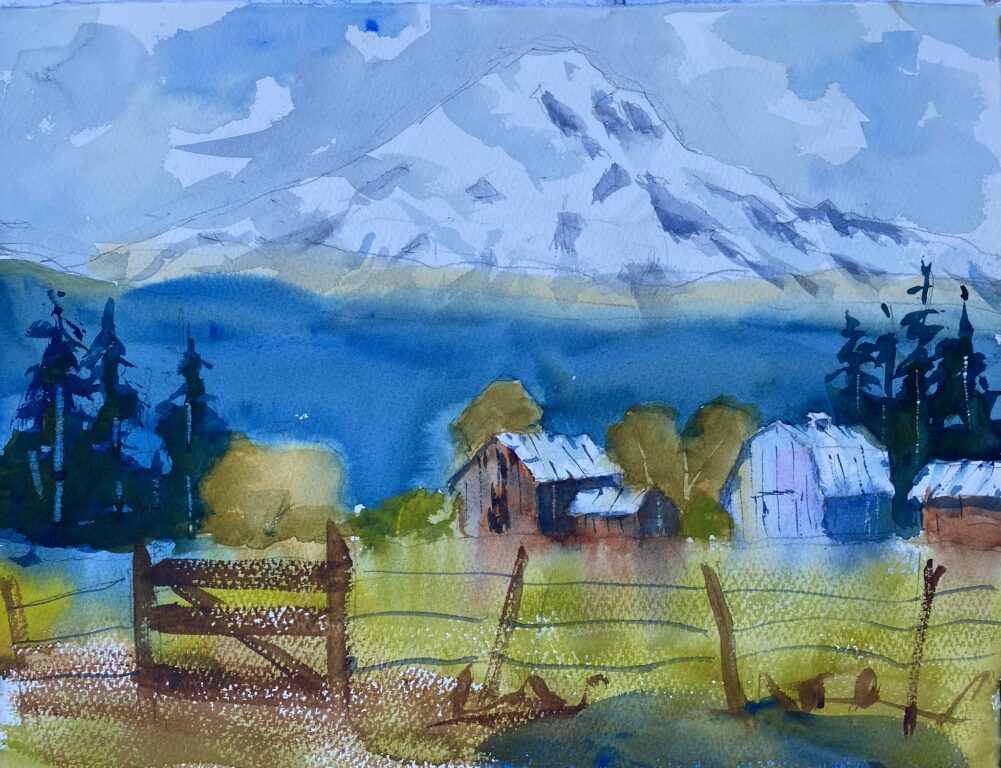
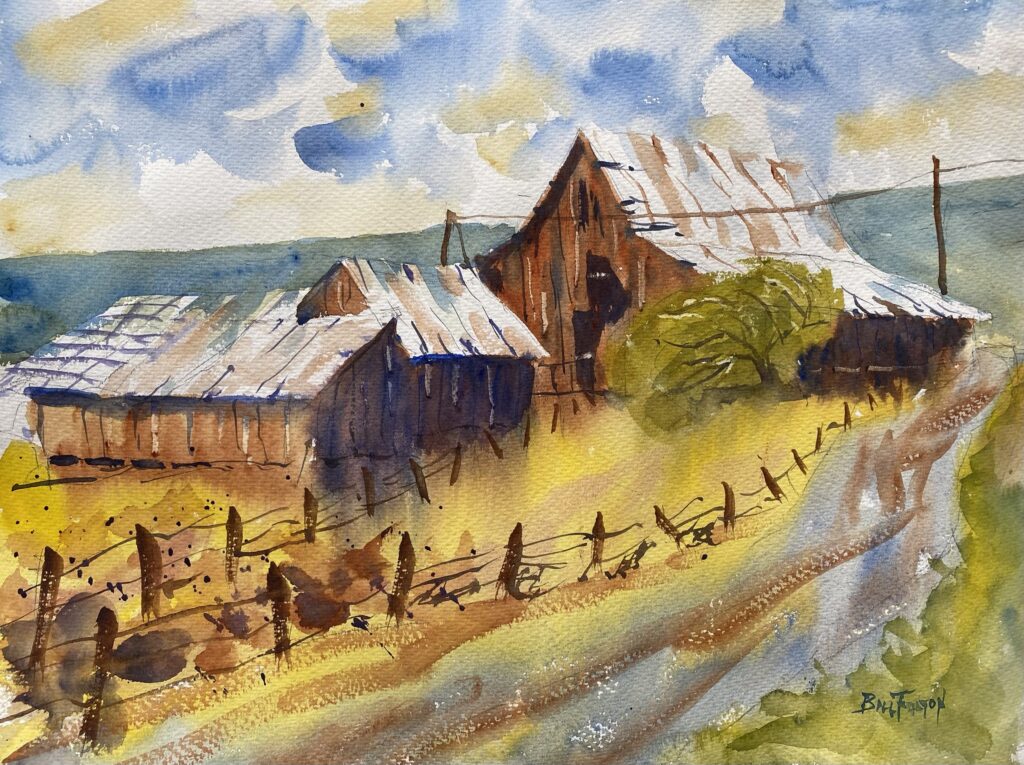
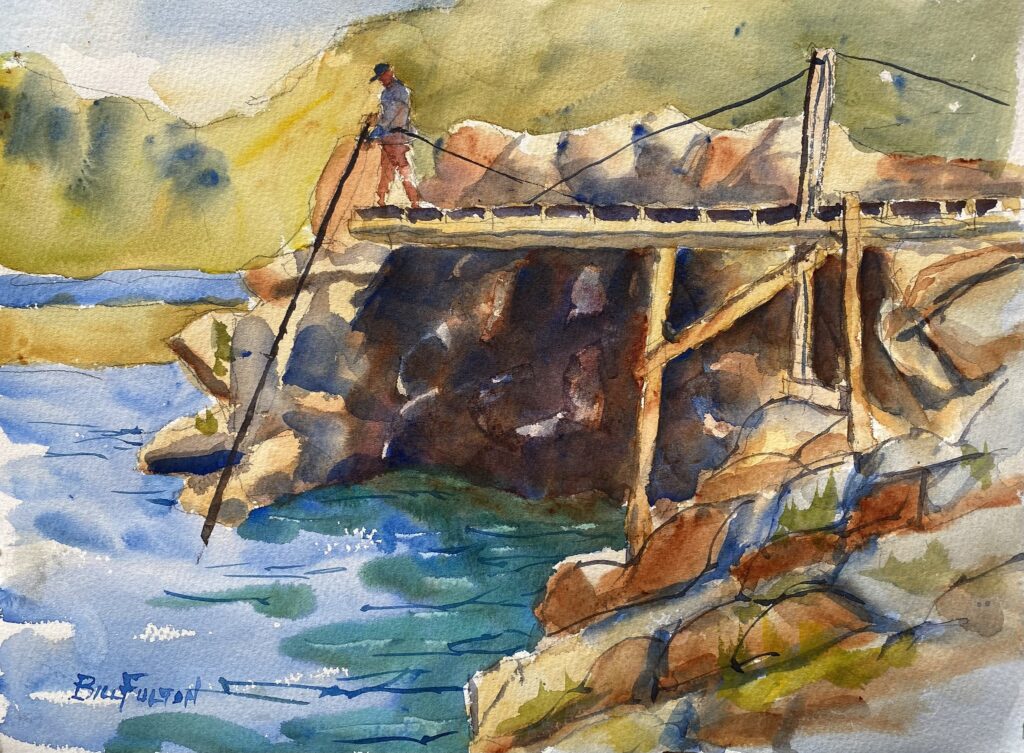
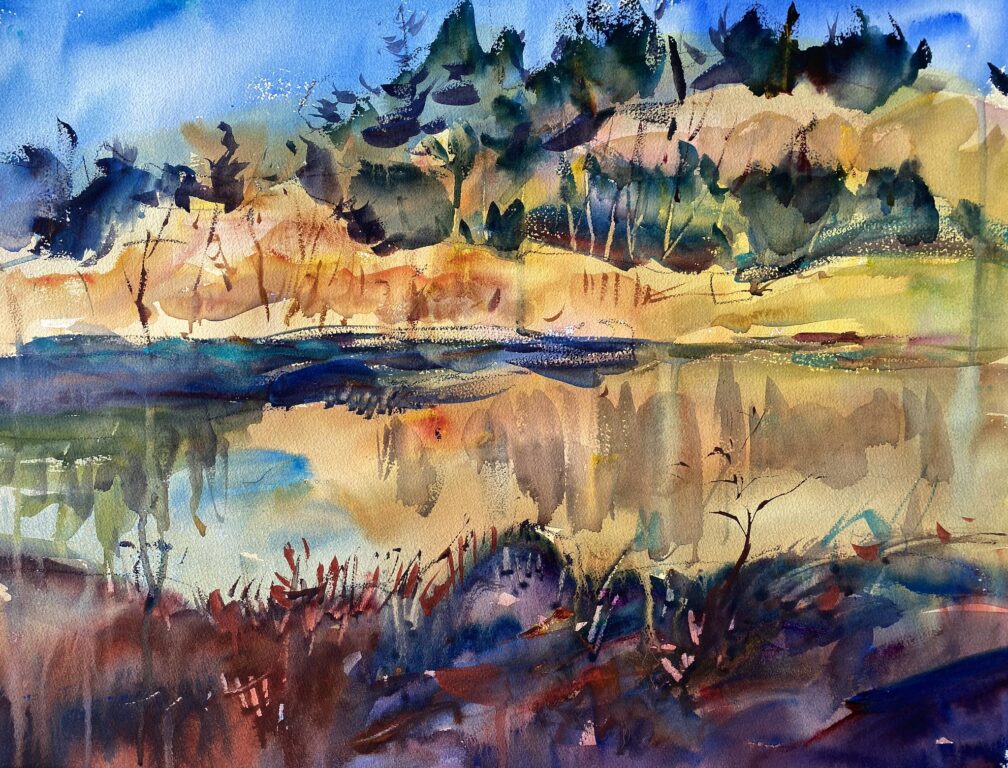
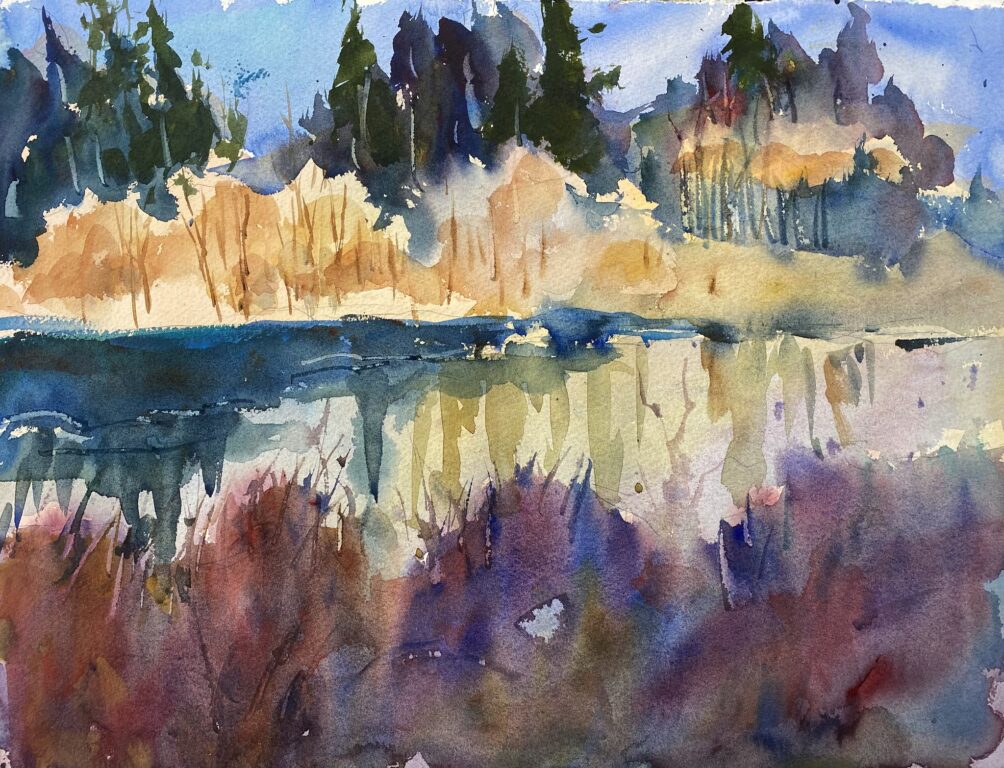
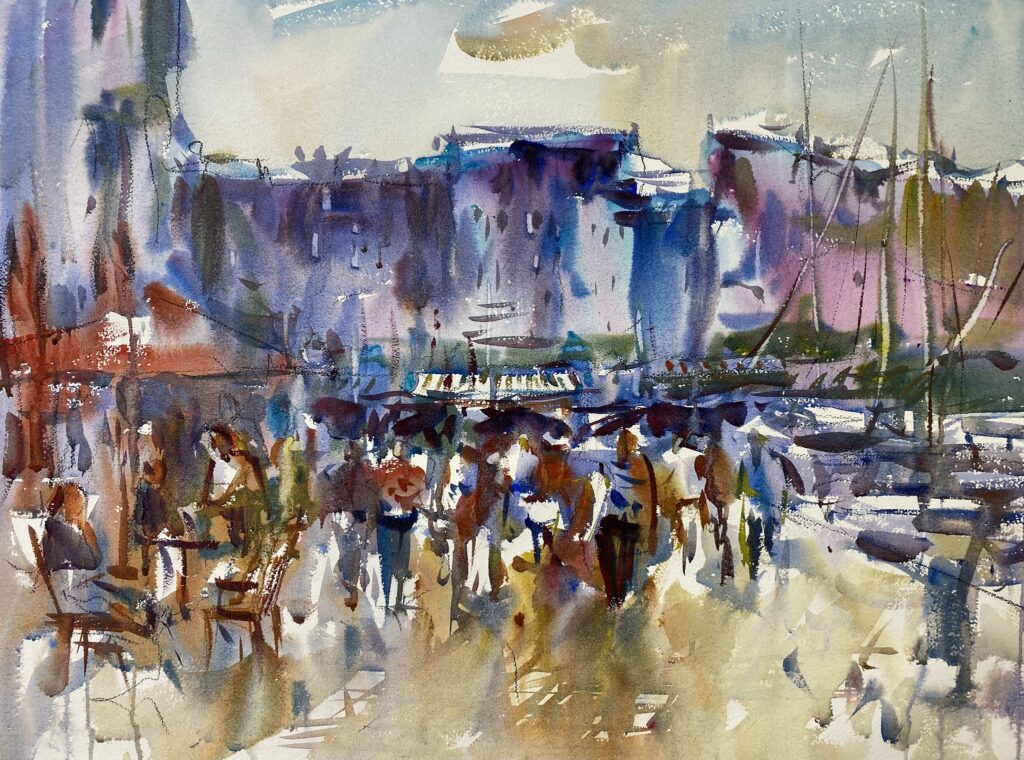
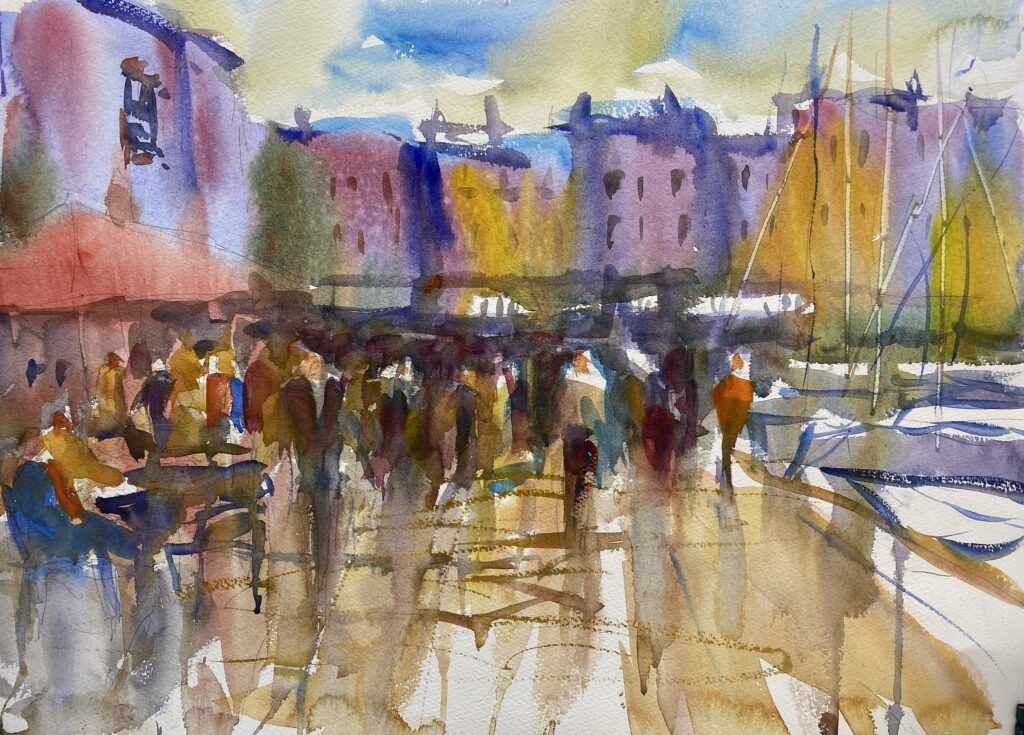
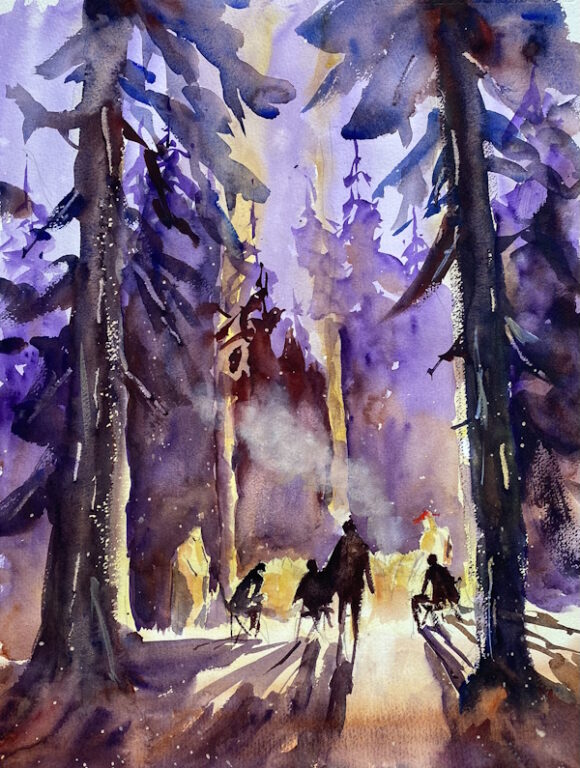
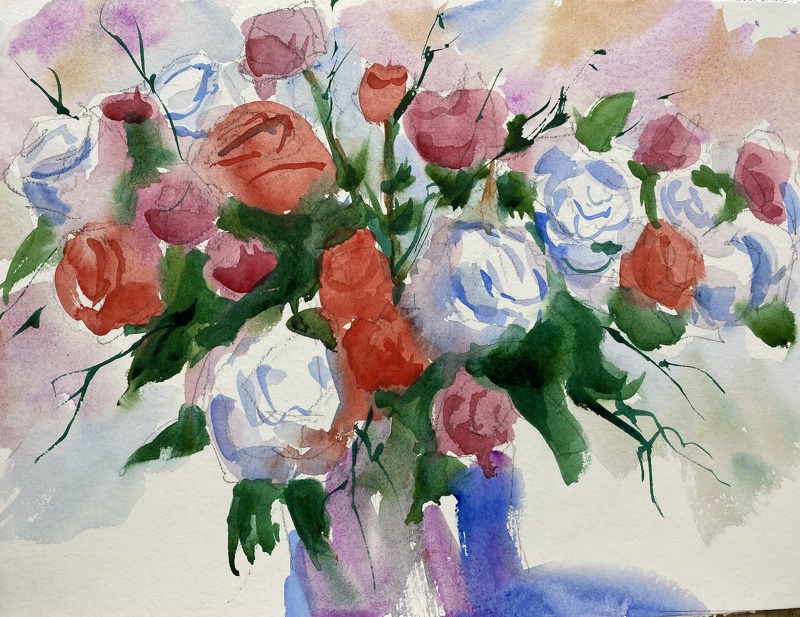
Recently I entered several paintings for selection in the Cole Gallery show in Edmonds, WA. They encouraged artists to submit smaller plein air paintings along with the same subject painted in the studio in a larger size. So I took some of my quarter-sheet paintings (11 by 15 inches) and painted the same subject again in a larger size, 16 by 21 inches. Here are the results in comparable sizes. Do you think that the larger paintings, which were painted more slowly and leisurely, are better than the smaller paintings, which were done quickly?
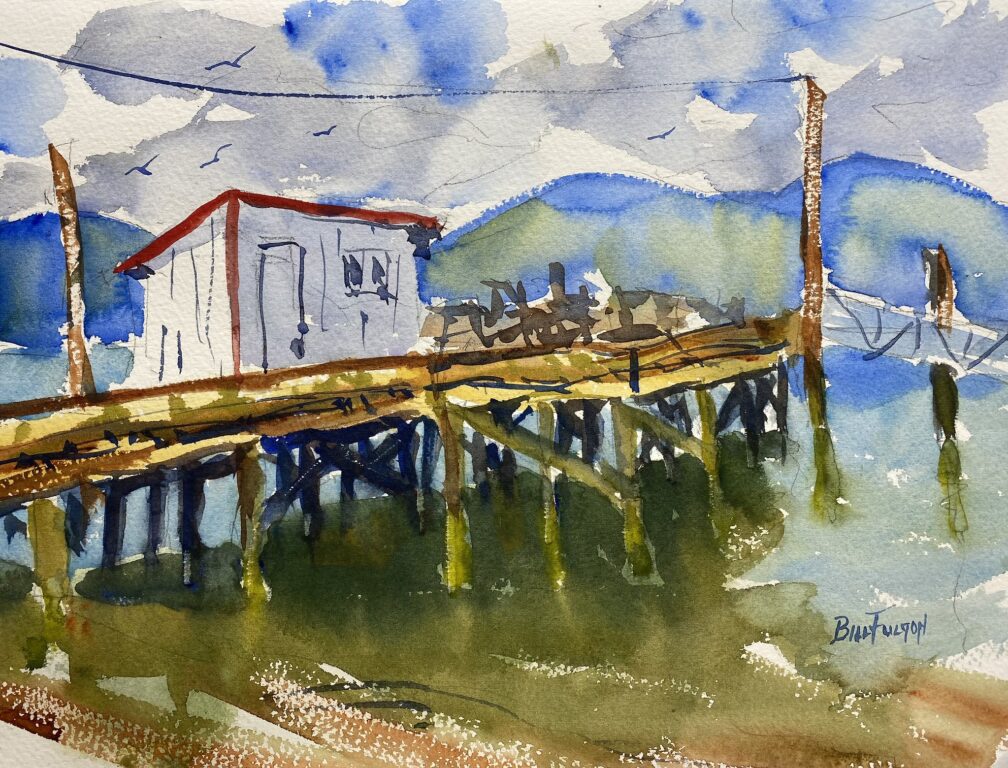
The first pair are paintings of Port Orchard Railway Marina. The buildings on the dock are actually green, but I changed them to red in the larger painting because I thought it would make a better contrast with the trees behind them. Oddly, I felt freed up as I painted the larger paintings, perhaps because I had more room on the paper to express the subject.
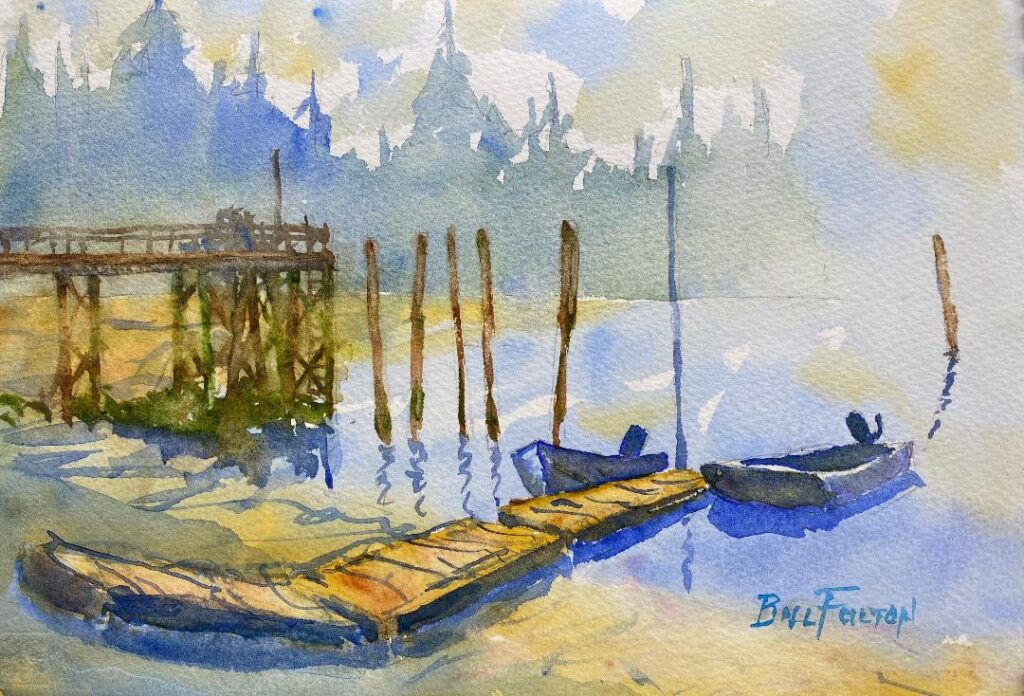
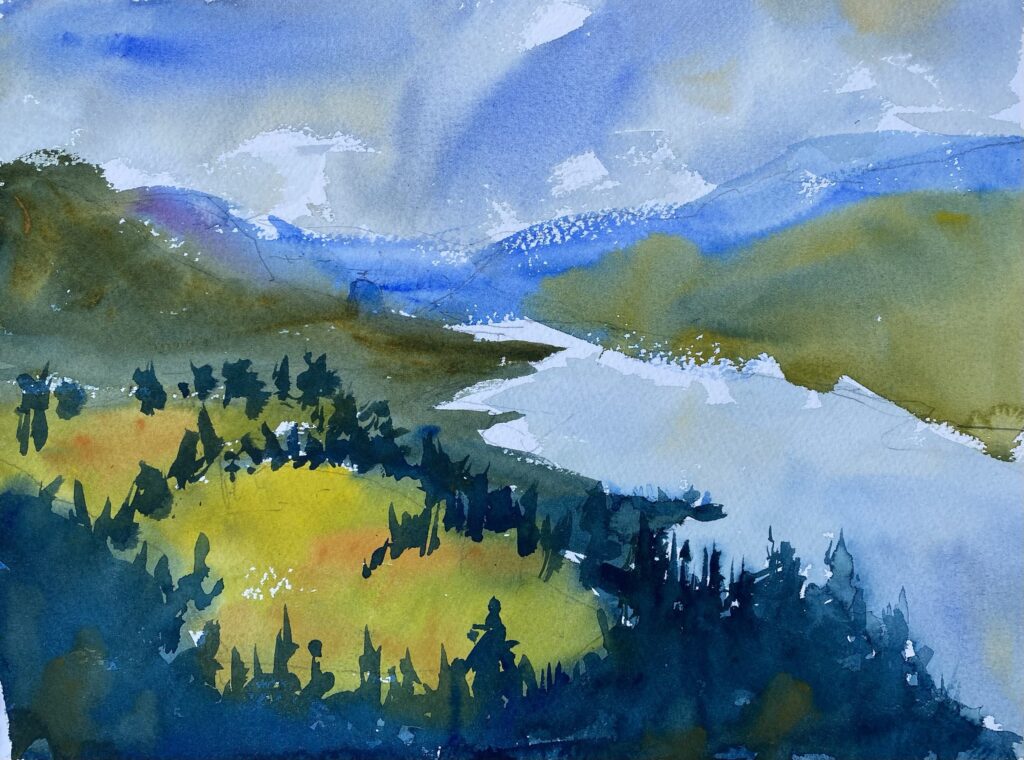
Port Orchard Railway Marina 11 x 15 inchesPort Orchard Railway Marina 16 x 21 inchesNorth Bay tree island 11 x 15 inchesNorth Bay tree island 16 x 21 inchesPlein air painting of Chico Creek, 11 x 15 inchesStudio painting of Chico Creek 16 x 21 inches
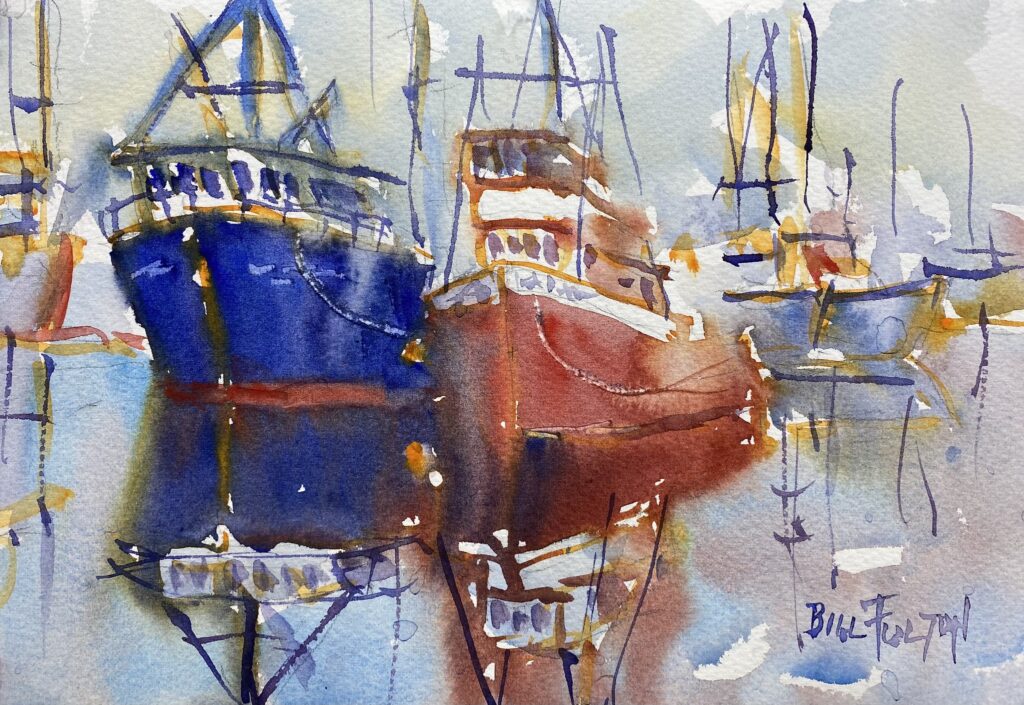
Two boats at Fishermen’s Terminal in Seattle, from a photo
Last week I focused on painting boats. Boats are great subjects because of their compound curves, their watery settings, their big shapes, and their delicate rigging. A boat has a purpose, whether its fishing or sailing, and that comes out in the painting. I painted these two boats from a photo, trying to keep them loose and wet so the colors would merge. I started by painting the outline of the boats in yellow, then I used a big brush and lots of paint to lay in the big shapes of the hulls, painting right down into the reflections all in one wash. I finished up with the rigging and a few vague indications of other boats in the marina. This is the way I’d like to paint boats.
Plein air painting of boats at Fishermen’s Terminal
On Wednesday, my son Guy and I took the ferry to Seattle and joined other painters with Northwest Watercolor Society at Fishermen’s Terminal. There are hundreds of boats to paint, of all sizes and shapes; a painter’s dream. These two boats caught my eye so I set up my easel and went to work. I like the painting, especially the blue boat, but I think I got too caught up in the details. Still, I like the way the eye goes to the boathouse on the right. When we finished, we joined about twenty other painters to show our paintings to one another.
F/V Karolee at the Port Townsend marina
On Thursday I drove to the Port Townsend marina and boatyard that is chockablock full of boats. I picked out these two vessels and started to paint. At noon I took a break for a bowl of chowder at Sea J’s Cafe, a lowbrow cafe a few steps away with homemade tables, faded bumper stickers on the wall, and one hardworking young woman acting as cook/server/dishwasher/cashier. The chowder was delicious; lots of clams and bacon.
With a cup of hot tea supplied by my thermos, I finished my painting. It wasn’t bad, but I thought I could do better, so I painted a second version that you see here. I like the shape of the Karolee and the focus on the white cabin, and the reflections aren’t bad. But I got balled up on the details again. It’s so hard to simplify.
When I finished, I showed the paintings to the young woman in the cafe, and she approved of them. Taken altogether, I’m pretty happy with a week of painting boats.
Last week Katy and I stayed at Lake Crescent Lodge. It’s our fourth year to enjoy the historic old lodge, the fall colors, and the cool, rainy weather. We especially like the evenings, when we curl up in the sofas in the big lobby. The roaring fireplace, dark beams, and friendly atmosphere with other guests make it a favorite for us. A plaque says that FDR stayed here in the 1930’s, and it looks little changed since then.
In the morning we ate a leisurely breakfast in the dining room that looks out on the lake. Afterward, Katy took a long exploratory walk along the lake while I painted a watercolor of the lodge. This painting carries good memories of our stay.
When I finish a painting, I take it back to the studio and critique it. Does it need something more? Should I try to touch it up?
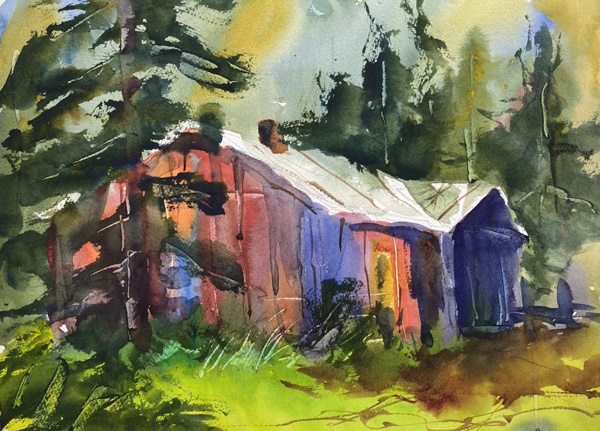
It can be dangerous to fiddle with a painting. Often you only make it worse with additional brush strokes. Besides, you lose the spontaneity of the fresh painting. But sometimes it can be helpful to make improvements. In this case, I brought my plein air painting (below) to the group critique with my teacher Eric Wiegardt. He said that I had a split area of dominance and suggested that I darken the sky and the shed on the left side of the painting in order to bring the eye to the barn on the right. Compare this with the improved painting (above) and see what you think.
Last summer I prowled the marinas of Port Orchard, a waterfront town on Sinclair Inlet. I took lots of photos and today I painted this watercolor. I like the looseness of the brush work and the general composition. The dark shadow under the dock is a main feature of the painting, leading the eye from the boat up to the building on the dock. The buildings were green, but I wish I had made them a different color to set them apart from the trees in the background.
I painted this watercolor while I was at the weekly meeting of Poulsbo Artist League. About fifteen of us meet each Wednesday afternoon in the parish hall at Vinland Lutheran Church near Poulsbo. It’s a chance to be with other artists and get some art work done at the same time. I’ve been a member for over fifteen years, so I know the other artists well. We are (you might say) mature artists, the average age being well over seventy five. These are my painting buddies.
Last Friday and Saturday Katy attended a writer’s workshop in Centralia, WA. I tagged along as her support team, but while she was in her sessions, I explored the surrounding countryside and painted these Centralia watercolors. I found winding valleys of grassy pastures beneath forested ridges, and lots of farms, barns, and sheds to paint. I especially liked the grouping of barns and sheds in the above painting.
This is the W.O. Willen farm, a historic property on Lincoln Road. I especially like the combination of red roofs and white buildings with shadows. While painting it, a man and his wife stopped in their pickup truck. The man has built hundreds of barns, and now spends his retirement repairing and restoring old barns. I’m glad someone cares for our rural heritage.
Farm on Teitzel Road
The setting for this farm is stunning. I found it at the end of a winding valley of grassy pastures. There were no other farms around; it was pristine. Before I started painting, I went up to the farmhouse to ask for permission to paint, bu there was no one home. So I set up on the county road. Just as I was finishing, a Sheriff’s Deputy drove up to check me out. He said that someone had called in a suspicious car parked on the road. I showed him my painting and he understood right away what I was doing. He liked the painting, too!
Farm on Shafer Road
I liked this collection of buildings on a hill above Salzer Valley. As I was painting, a small herd of curious goats came out to check me out, bleating as they came. Later a tall young man strolled down the lane to see what I was doing. When he saw I was painting, he was quite friendly.
Katy and I stayed at Centralia Square Grand Hotel, a historic hotel in downtown Centralia, and we ate at McMenamin’s, located in the old Olympic Club. I found Centralia to be a charming small town (as long as you stay off the Interstate exits).
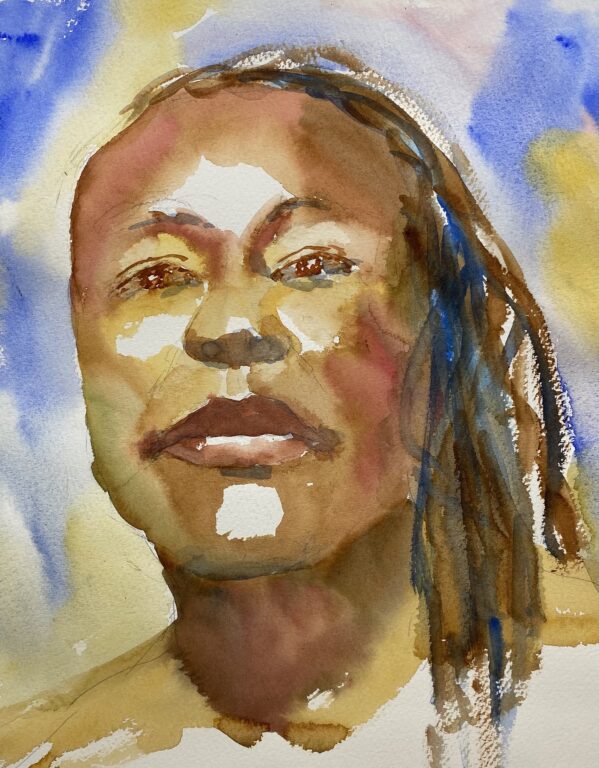
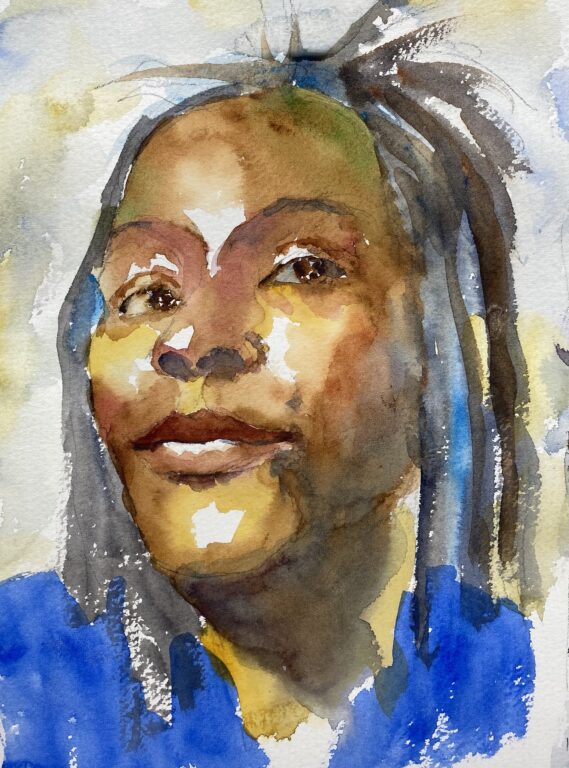
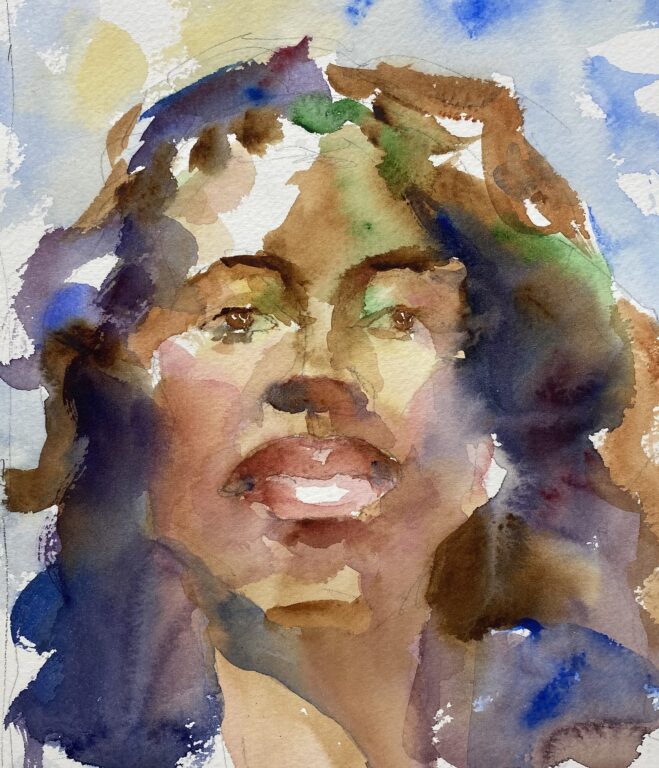
After my week-long plein air competition in Whidbey Island, I was a little burned out on landscape painting, so when I got home, I turned to portrait painting. Here’s a video of a portrait painting session I made recently. I got the reference from an app called Museum (or Sktchy). It provides thousands of photos of users for you to draw or paint and upload to the app. I’ve drawn or painted about 150 portraits for this app.
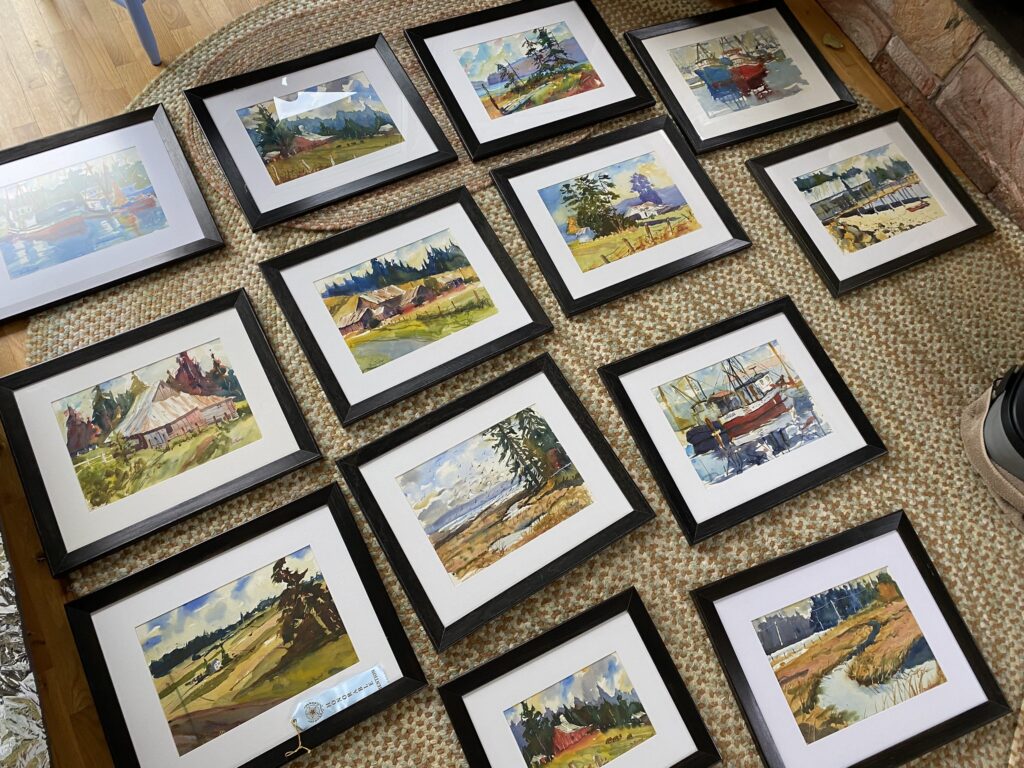
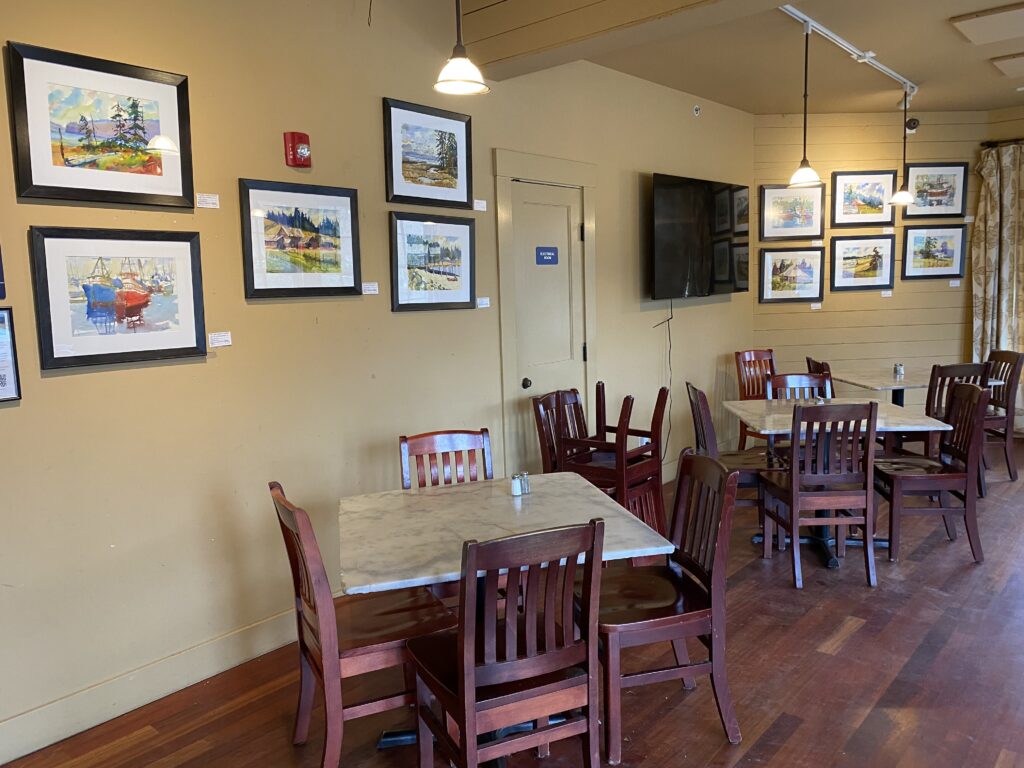
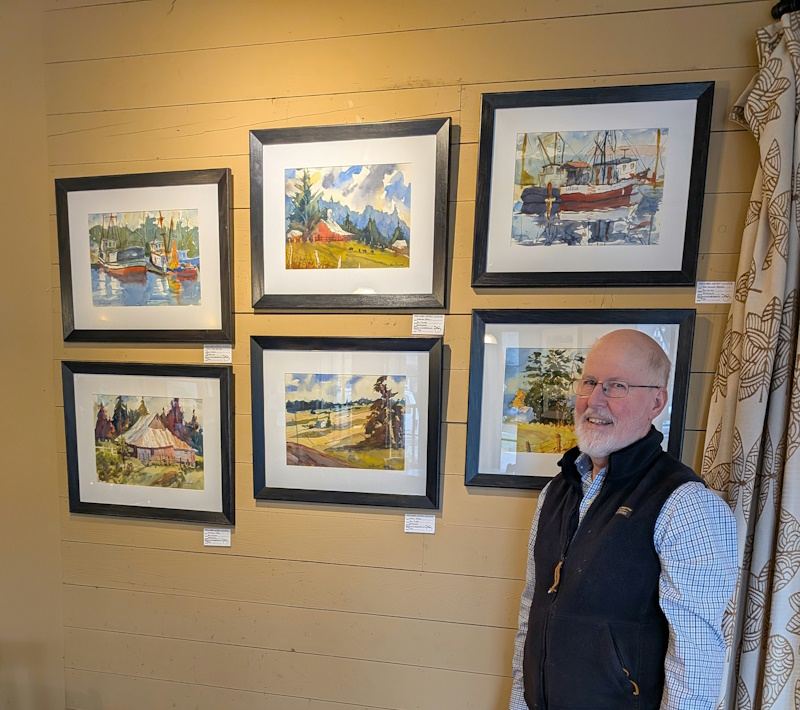
Last week this painting earned an Honorable Mention ribbon at the Whidbey Island Plein Air competition. I spent four days painting on Whidbey Island with 50 other artists, ending with an exhibition of our paintings on Thursday night. There were some great paintings there! Whidbey Island is quite picturesque, especially the area near Coupeville where Ebey’s Landing Historical Reserve is located. The Reserve was created to preserve the farmland and farms that were established by the first settlers in the nineteenth century.
I painted ten paintings over the course of the four days, which is a lot for me. Since this is my third summer at this event, I had a better idea of where to look for subjects, so I didn’t have to drive around as much. It was fun seeing other artists as they painted with me and at two dinners hosted by the organizer, Pacific Northwest Art School. I camped out at Fort Ebey State Park, and enjoyed good weather until Friday, when it rained. Here are some of the paintings I made in addition to the one above.
My son Guy and I returned to the Washington coast July 16-18 as I was the facilitator for a Plein Air Washington Artists paintout. As facilitator, I had to organize and publicize the event back in February, which took a flurry of activity. Then at the actual event, I was the on-the-ground coordinator, helping people find the gathering places, answering questions, and facilitating a review at the end of the first two days. We had about 15 people and I think everyone enjoyed the camaraderie and the great painting opportunities.
The first day we painted on Rialto Beach with its crashing waves and sea stacks. The second day we hiked .7 miles to Second Beach where we had a variety of islands, outcroppings and beach scenes to paint. On the third day we painted in the harbor at La Push, with its boats, docks, and the offshore islands looming over the harbor. What a great place to paint!
Artists at Second BeachReview at the end of the first dayMy painting of Rialto Beach
On Saturday I attended a paintout sponsored by Magnuson Park Gallery in Seattle. Magnuson Park is a former Navy Air facility that was transferred to the City of Seattle. Most of the buildings and grounds have been re-purposed in imaginative ways, but some of the buildings stand unused and abandoned, like this old Navy hangar.
I liked the grittiness of the scene with the broken windows, so I tried to capture it in a watercolor. I like the color of the walls and the windows, but I struggled to paint the tree and its beautiful shadow. But all in all, I’m pretty satisfied with this painting.
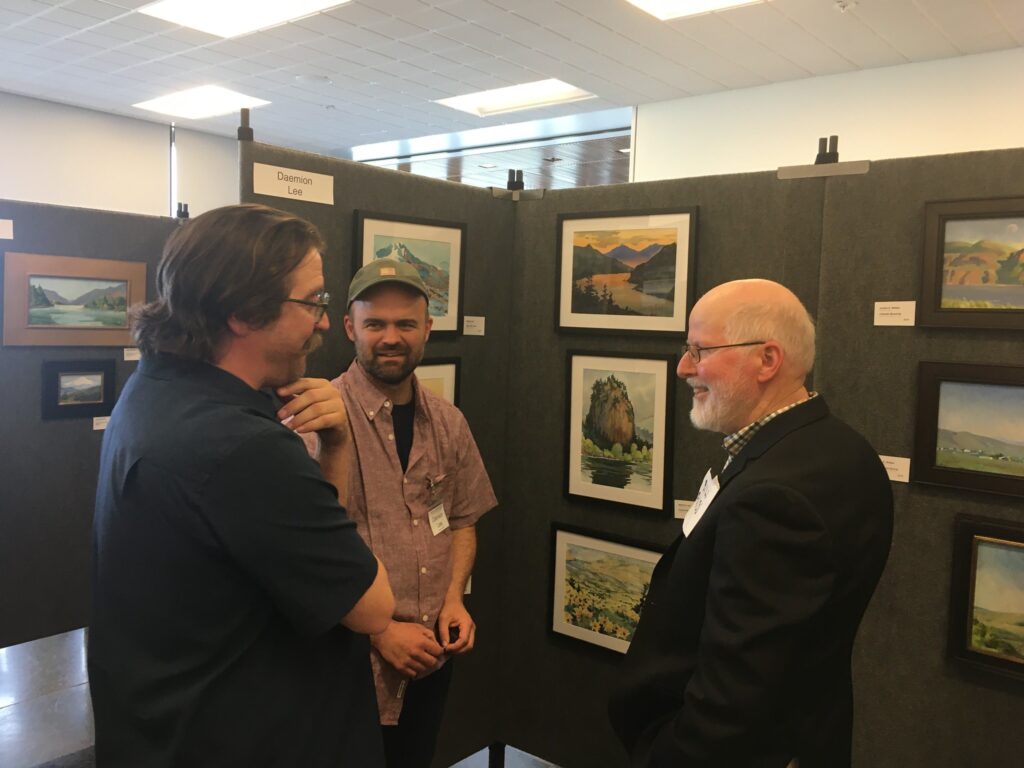
At 3:00 pm, all the artists gathered in the Magnuson Park Gallery to show their work. I especially enjoyed seeing my fellow artists, many of whom I know already, and striking up conversations with those I haven’t met. There were a number of young artists there, and I tried to make encouraging comments on their paintings.
With two ferry crossings and congested driving in Seattle traffic, it was a long day for me, but a rewarding one.