Watercolors

A good day of painting in Seattle

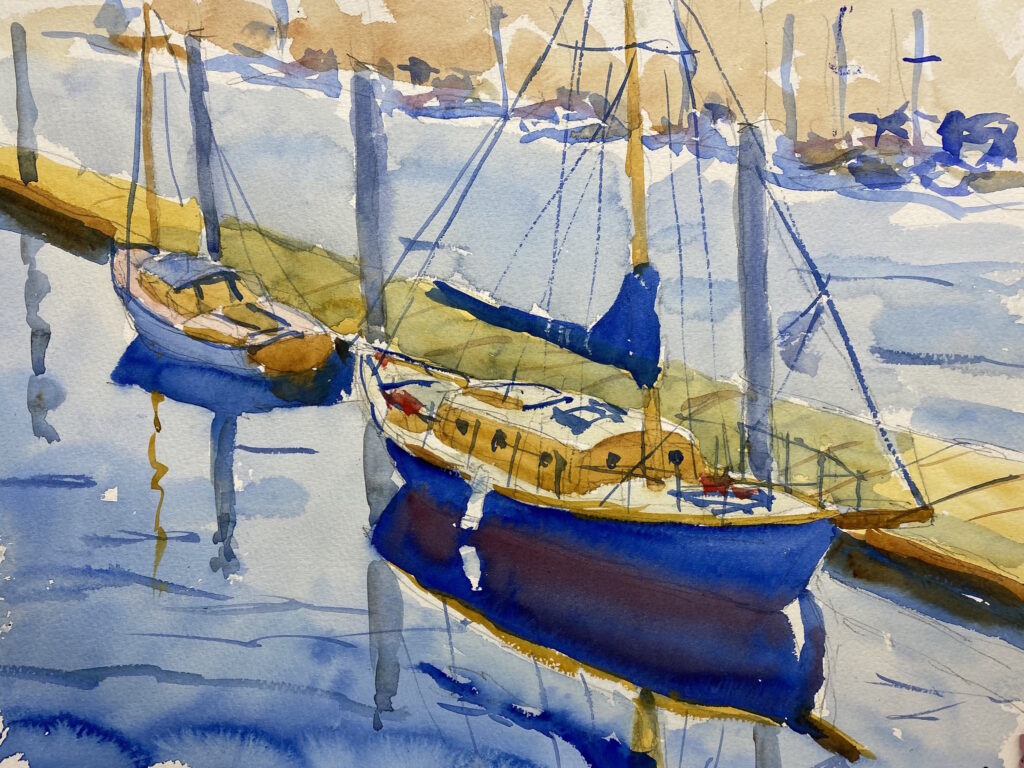
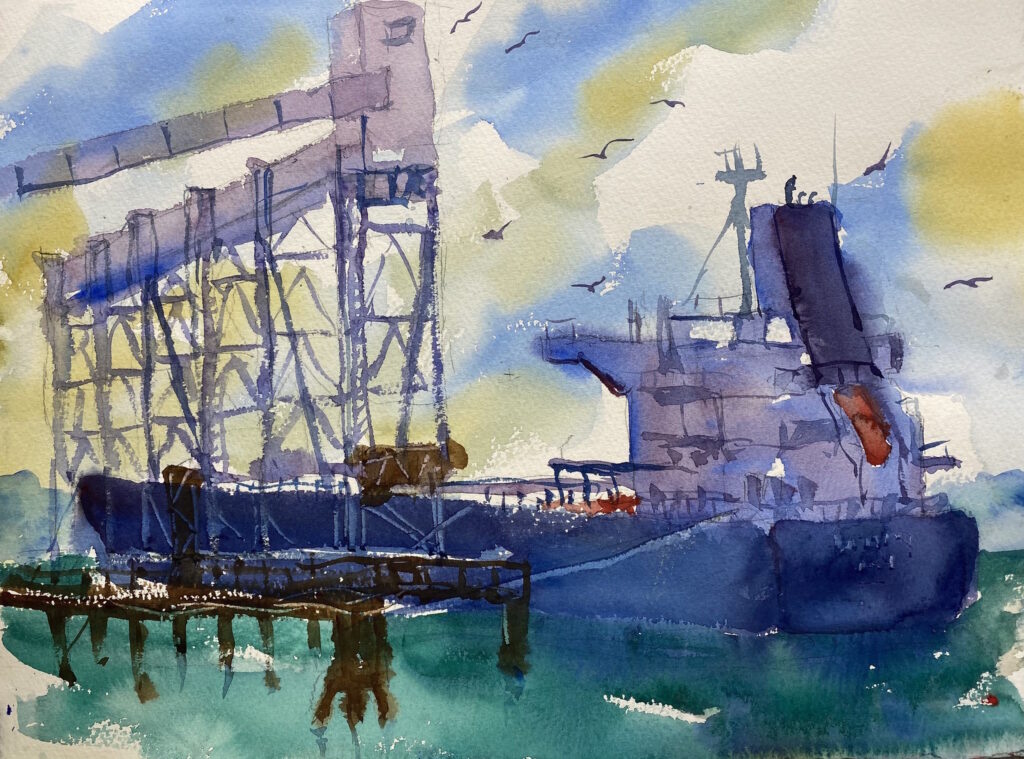
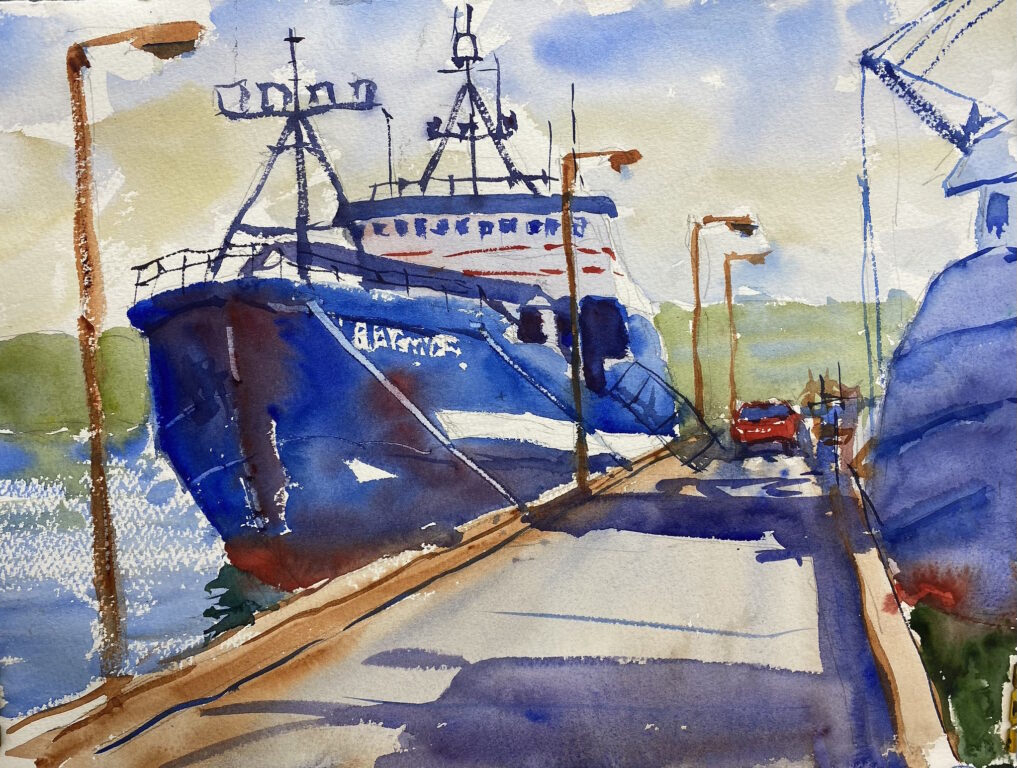
The fishing vessel Baranof at the dock at Fishermen's Terminal in Seattle.
The fishing vessel Baranof at Fishermen’s Terminal in Seattle

Last Wednesday I took the 7:20 am ferry to Seattle so that I could paint with members of Northwest Watercolor Society (NWWS). This group meets at paint-worthy locations every Wednesday to paint together and share their work.

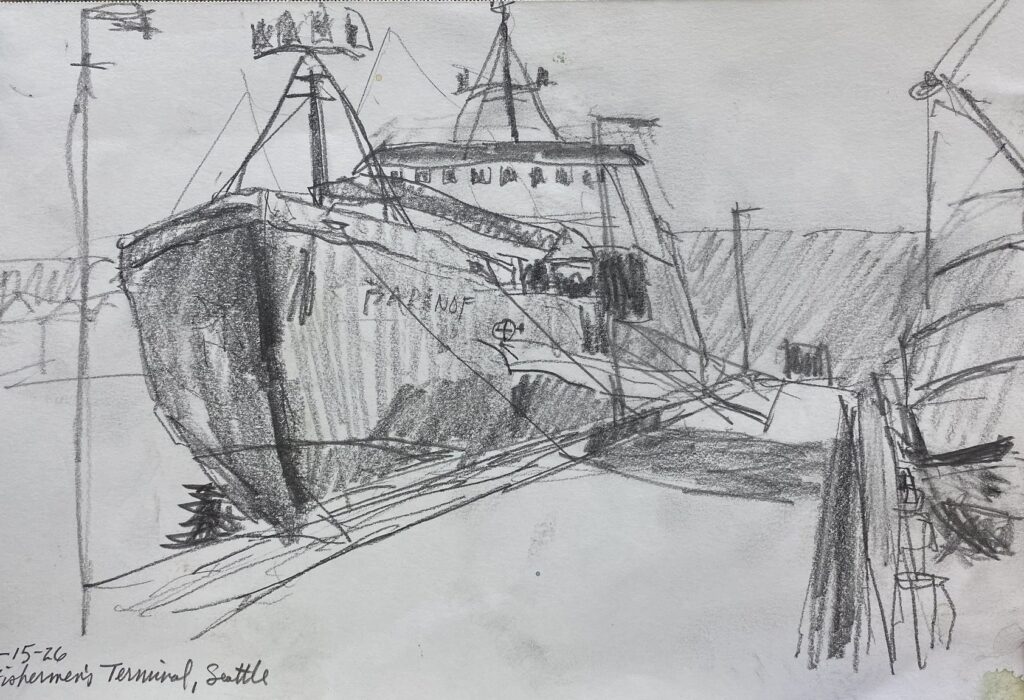
I arrived in Seattle at 8:20 and drove to Fishermen’s Terminal to get in a painting early in the morning. I strolled the docks and found a row of big fishing boats, including the F/V Baranof. There was a big shadow from another boat, so I set up my easel and made a pencil sketch in my small (5 by 8) sketchbook. I always make a pencil sketch first so that I can get the composition right and establish the values of the painting.

My pencil sketch of the Baranof

In this case, the dock naturally led the eye toward the boat, and later on a red pickup truck conveniently drove up and parked next to the boat. Nice subject! After I drew the shapes of the boats and the dock, I used the flat of the pencil to show how dark each shape was. The shaded side of the boat was very dark, and the light side of the boat was very light. Then I filled in the other values: somewhat dark, medium, and somewhat light.

Next I drew the composition on my watercolor paper and paused. The moment before picking up the brush is always a scary moment for me. What if I ruin it? What if I don’t know what I’m doing?

But I chase those thoughts away and make my first brush stroke. From then on, I’m in the zone. The painting unfolds as I go, and time seems to disappear as the painting overtakes me. I paint the boat hull, the opposite boat in shadow, the docks and the light poles. Then on to the surrounding shapes, finishing up with the rigging, the water, and the sky.

I was pretty happy with this painting. I think the mass of the boat attracts the eye and provides a good shape for the rest of the painting to relate to.

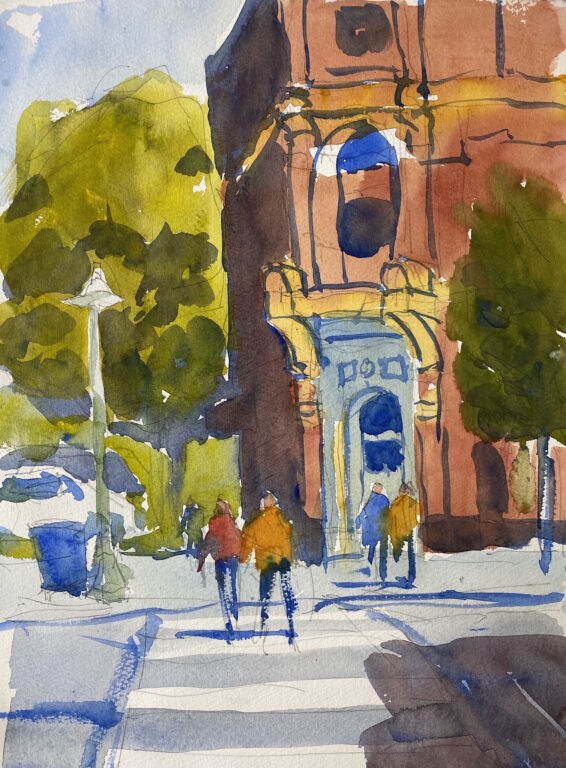
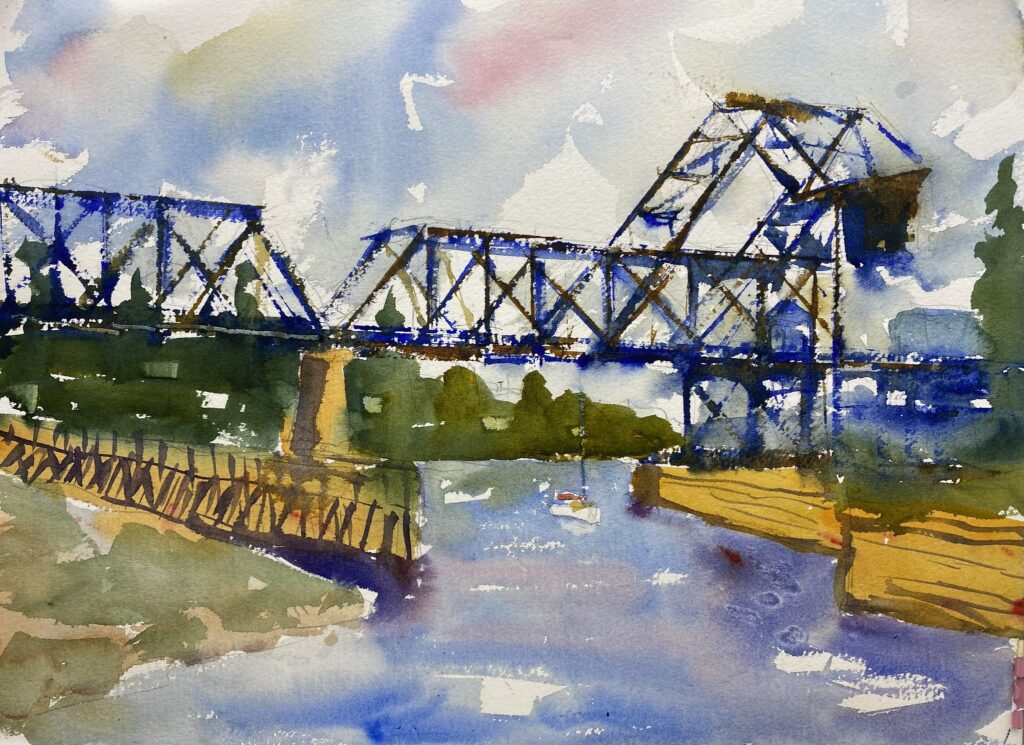
The old railroad bridge over the ship canal in Seattle.
Railroad bridge over the ship canal in Seattle.

Then I packed up my gear and drove to Commodore Park, where NWWS members were gathering. Commodore Park is located alongside the Seattle Ship Canal, which provides a waterway from Elliot Bay (the ocean) to the fresh water of Lake Washington. Locks are provided so that boats can be raised or lowered to transit the canal.

It’s a beautiful location with lots of activity. Docktenders guide the boats that are entering or leaving the lock, and Seattleites of all descriptions are milling around the locks. Birds flit about, raccoons scurry on the shore, and an occasional seal can be seen in the water.

I scoped out the park and found a location alongside Diane, who had already started. I chose to paint the rusty old railroad bridge over the canal. I used an old credit card to paint the girders of the bridge. First I mixed up a good amount of paint in my palette, then I rubbed the edge of the credit card in the paint and applied it to the paper. The marks it makes are just right for girders and cranes.

After that, I painted the rest of the painting with the brush. I felt pretty good about this painting. Afterward, I joined about twenty other NWWS painters for the “throwdown”. We all prop up our paintings against a wall so that we can see what everyone has painted. Not only is it fun to see what other painters have done, it’s a great way to learn about other styles and perspectives. I enjoy rubbing elbows with the artists and I try to make contact with as many people as I can.

I drove to the ferry and napped in my car while waiting. It was a good day of painting.

A good day of painting in Seattle Read More »

Review of Eric Wiegardt Watercolor Workshop, July 2026

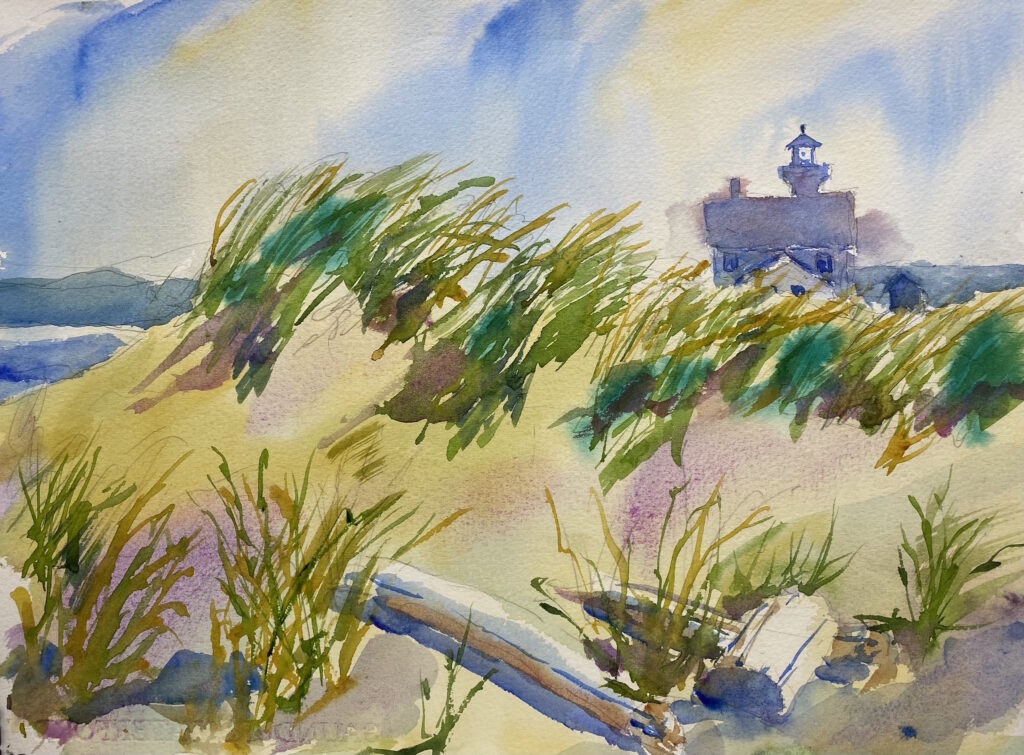
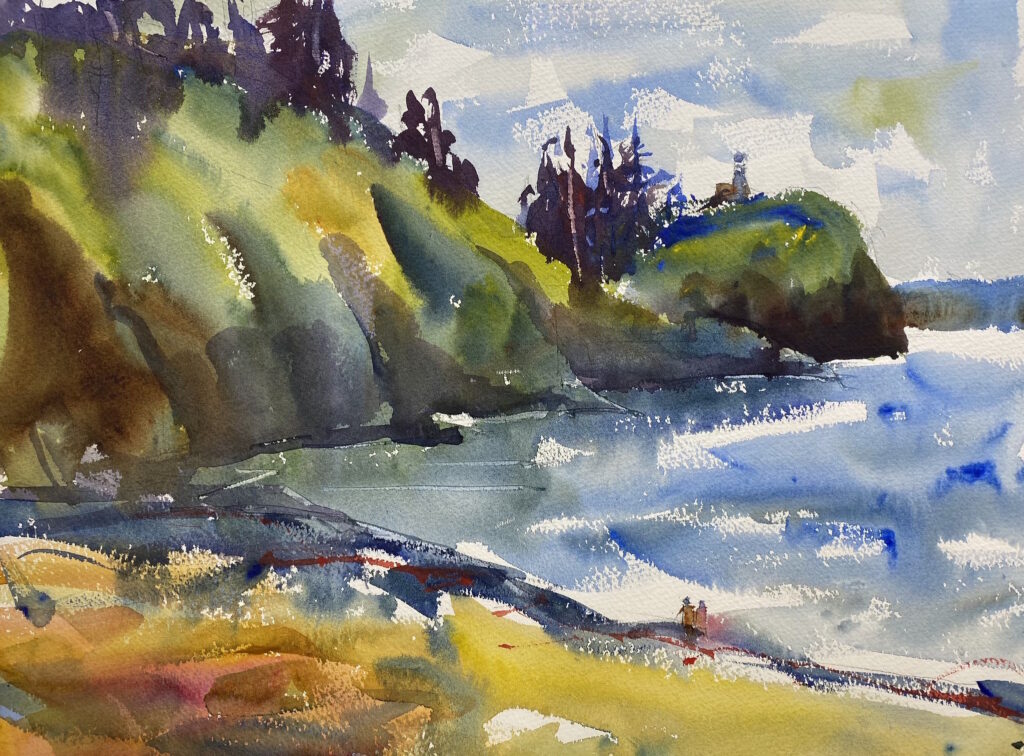
Cape Disappointment lighthouse

Watch, paint, review. Watch, paint, review. That was my week last week. I spent four days in Long Beach, WA, at a watercolor painting workshop by Eric Wiegardt.

The thing I enjoyed most was the camaraderie among the students in the workshop. I already knew Eric and eight of the seventeen students, so I felt right at home from the opening hugs. Everyone in the group seemed to fit together, and I enjoyed talking with everyone.

Every morning Eric painted a demonstration watercolor while explaining his technique. Then all seventeen of us students attempted to paint the same subject, bearing in mind all that Eric said. This process was repeated in the afternoon, followed by a critique of one of our paintings by Eric.

What did I learn at this workshop that I didn’t learn at the three previous plein air workshops I have taken with Eric?

Probably the most helpful thing for me was to simply watch how he uses his brush to grab pigment off his palette, mix it, and apply it to the paper. His emphasis on using wet pigment, his mixing of colors with the brush, his generous use of water in the brush, and his sweeping strokes on the paper encouraged me to be more confident in my painting.

“Make your first brushstroke a bold statement,” he said. I tried to follow that advice, and I think it helped.

Eric repeated his three basic goals for a painting: capture the eye at a distance, carry the eye throughout the picture plane, and bring the eye to the area of dominance. He gave us a number of tools to use to bring the eye to the area of dominance: contrast, line, placement, animation, warm colors, hard edges, big shapes, and detail.

Eric paints intuitively. That is, he feels his way through the painting, asking what the painting needs and responding to it. He’ll grab a color and try it on the painting, and if it feels right, he’ll go on. He doesn’t like to “go backward,” by scrubbing out a bad place or wiping out an awkward color. He prefers to move forward in the painting. 

If the painting has clear values and good interlocking shapes, then it will hold up well. You can use almost any color as long as you have good shapes and values.

He encouraged us to take risks. “If you’re not painting on the edge of your ability,” he said, “You’re not growing as an artist.”

On the first day, we painted the lighthouse at Cape Disappointment. (See my painting above) This is probably the most iconic subject in the Long Beach area, and I’ve painted it several times. This time, watching Eric, I was able to paint more boldly and decisively. I like the results, although my colors got a little dark in places. 

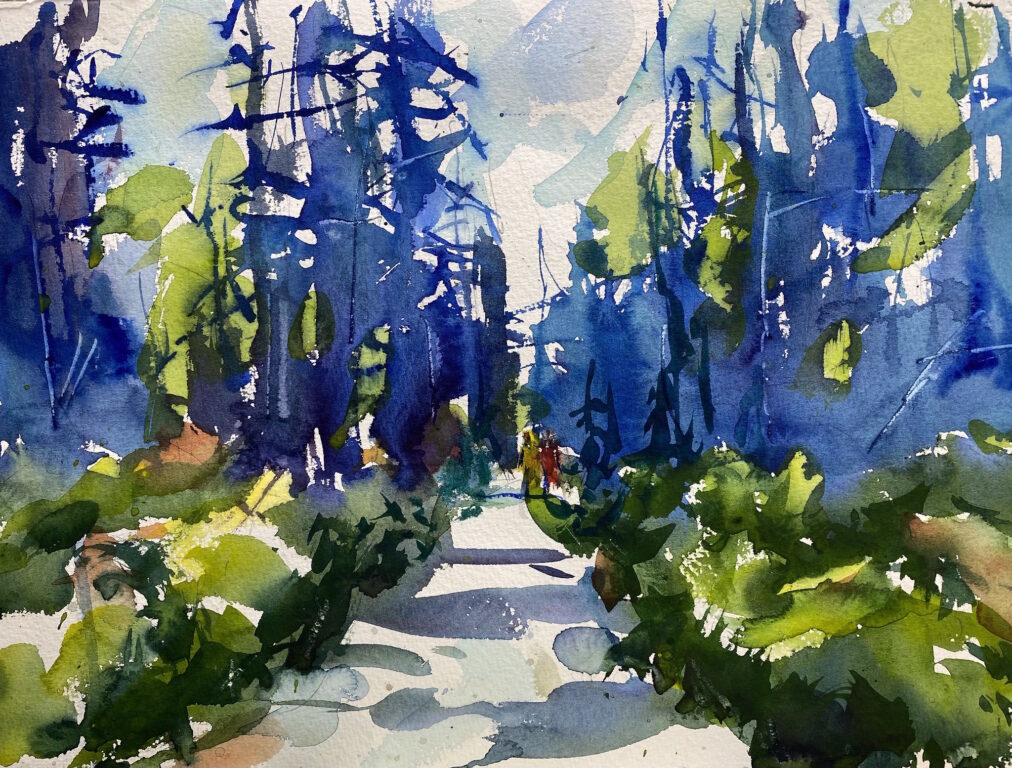
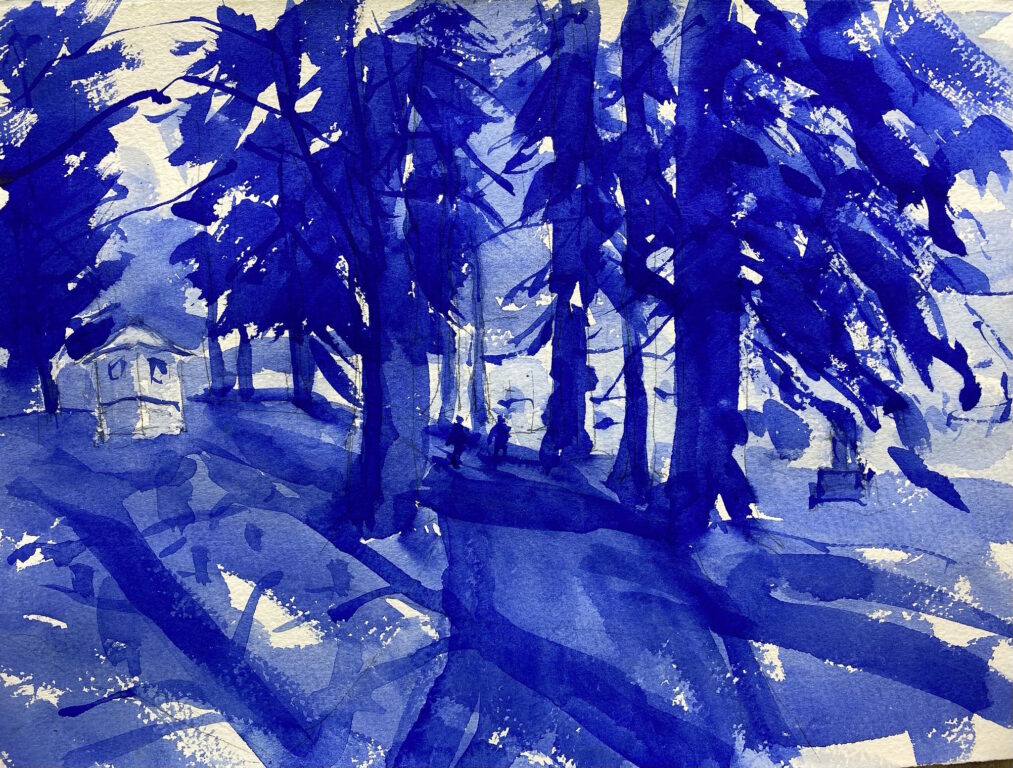
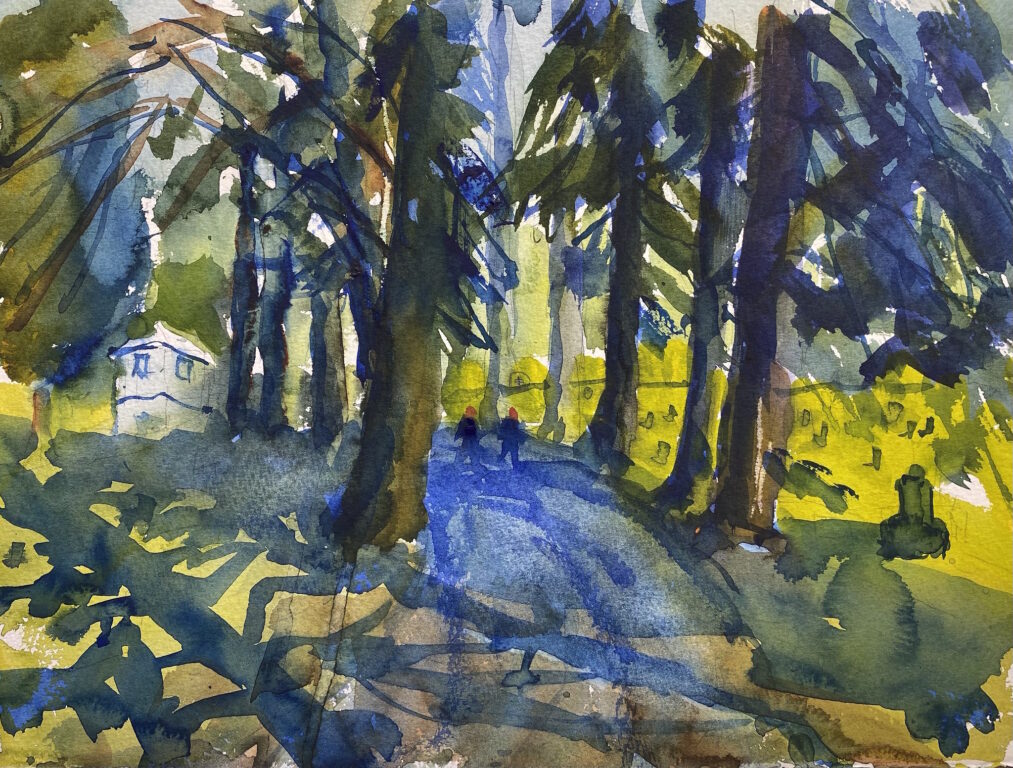
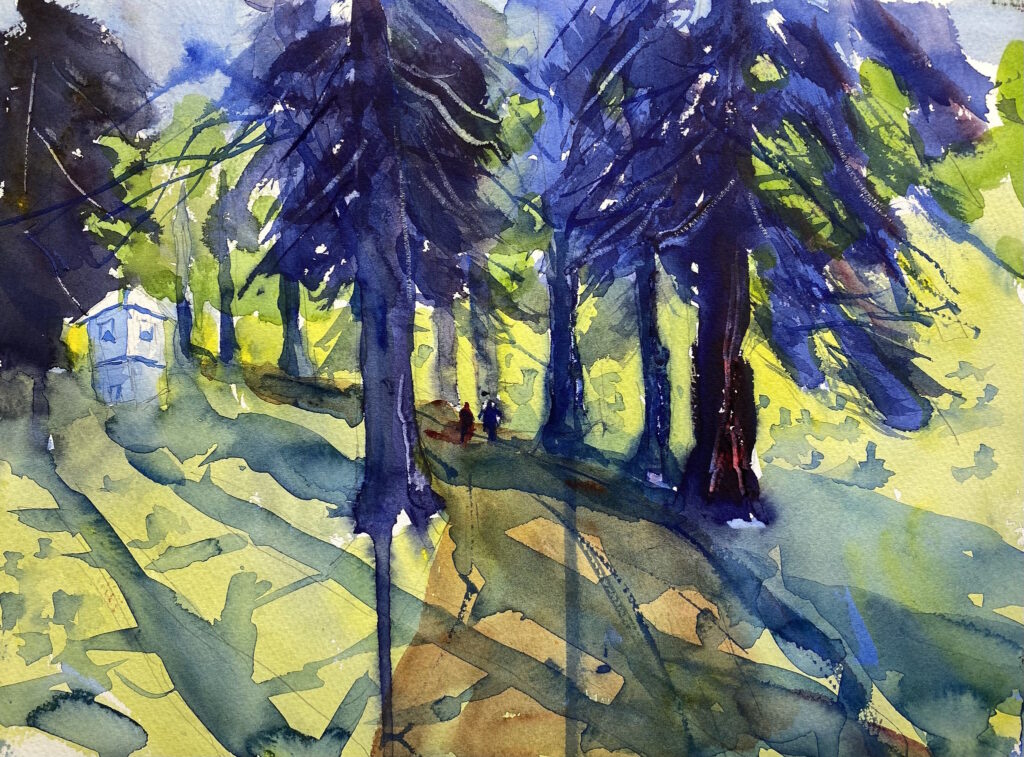
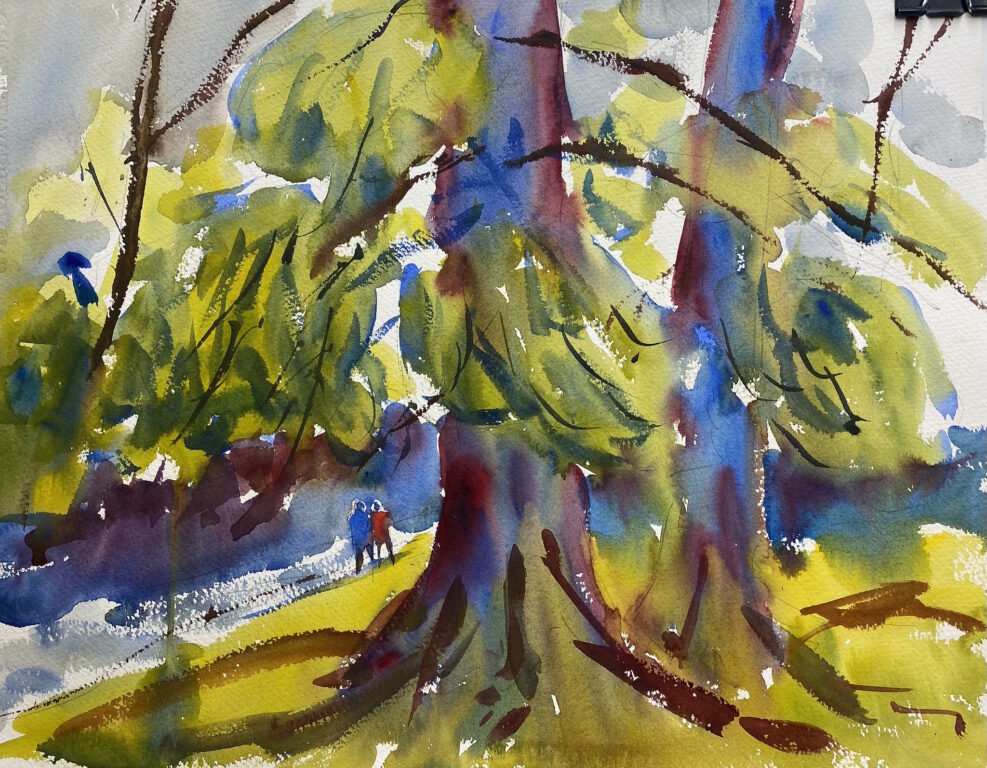
Spruce trees at Oysterville school

On the second day, we painted near the historic Oysterville school. Eric chose as his subject two big spruce trees with their cascading foliage. He added two figures walking on the road next to the trees.

I was pretty happy with my trees. I used a lot of vivid color in the trunks and managed to show the foliage adequately.

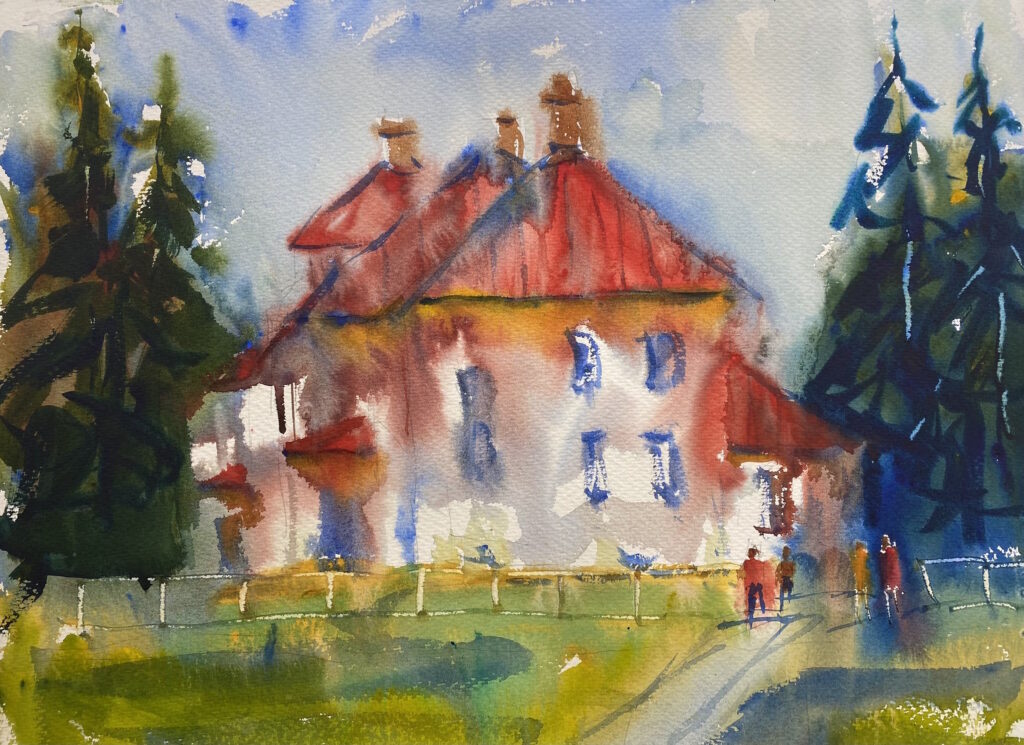
The lighthouse keeper’s house at North Head Lighthouse

On the third day, we painted the lighthouse keeper’s house at North Head Lighthouse. Eric emphasized using lots of wet pigment to let the colors blend. He wet the back of the paper to keep it moist, and he used a spray bottle to help the colors run.

I felt pretty good about my attempt to paint this building. My washes ran and blended together, maybe a little too much. But that’s how you learn. I was successful in getting my figures to blend into the colors around them, so they don’t look pasted on. On this painting, I was able to keep working the painting while the washes were wet or semi-wet, and that was a first for me.

On the fourth day, I was tired. Eric painted a floral arrangement provided by his brother, Todd, a professional florist. I enjoyed painting the flowers, but I was too worn out from a week of painting to really focus.

I camped at Cape Disappointment State Park, like I’ve done in years past. I enjoy camping, but I have to admit it takes quite a bit more energy, and I was in my sleeping bag by 9:00 each night. But all in all, it was a great week of painting and learning.

Review of Eric Wiegardt Watercolor Workshop, July 2026 Read More »

My painting was accepted!

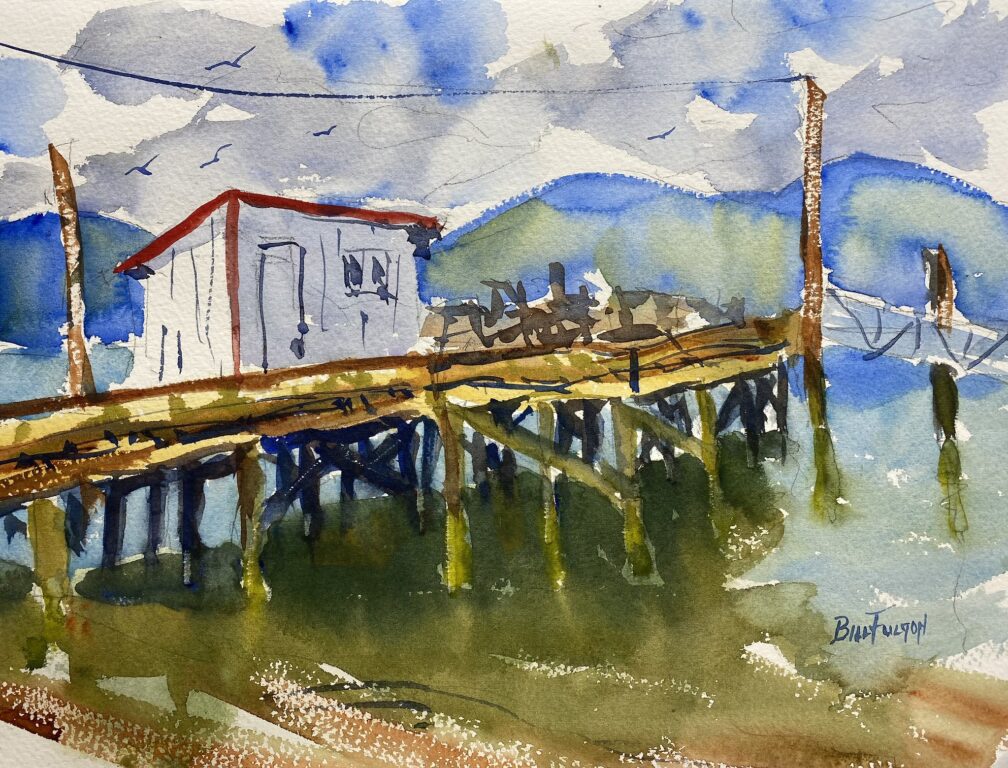
An oyster dock with a white shack at South Bend, WA
Dock at South Bend, WA

I’m very happy to say that this painting was accepted into the Little Gems Show at Scott Milo Gallery in Anacortes, WA. Of the three I submitted, this was the only one accepted, but I’m satisfied with that. I like the painting for its freshness and simplicity. Sometimes a simple subject is the best.

The show runs from July 30 to August 29. There will be about seventy small paintings from members of Plein Air Washington Artists. I’m intrigued to see the other paintings accepted into the show. Hopefully I can get to the opening on July 31 to see the artists and the awards ceremony. Unfortunately a trip to Anacortes and back, with the ferry ride included, takes the better part of a day.

My painting was accepted! Read More »

No barriers

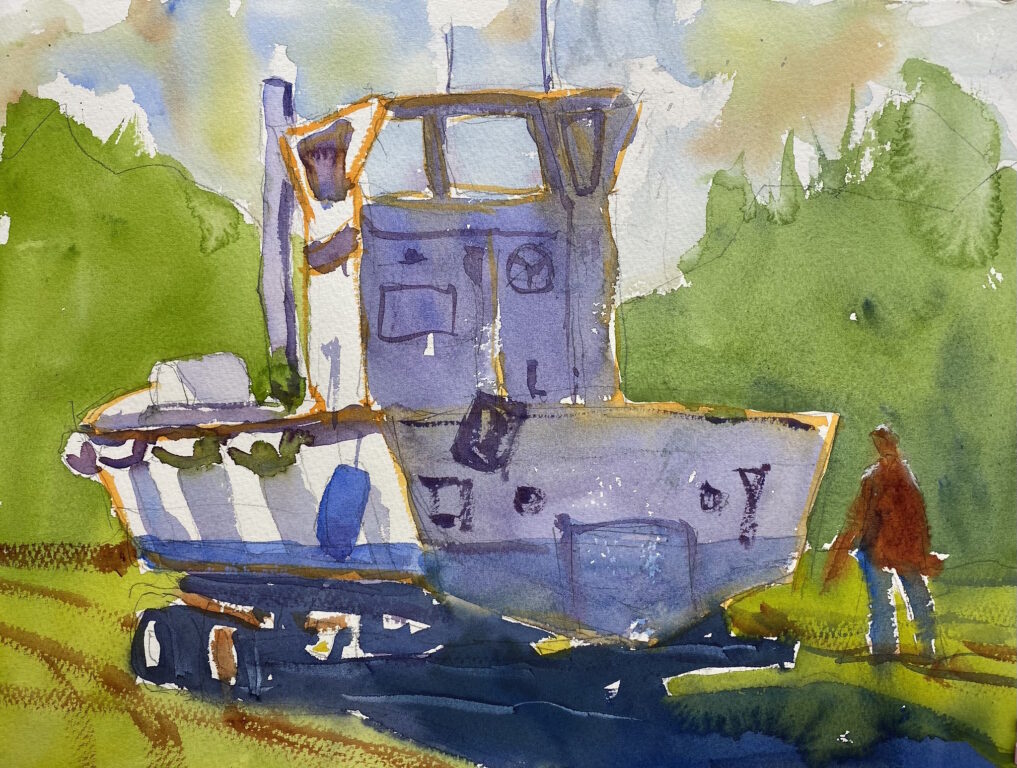
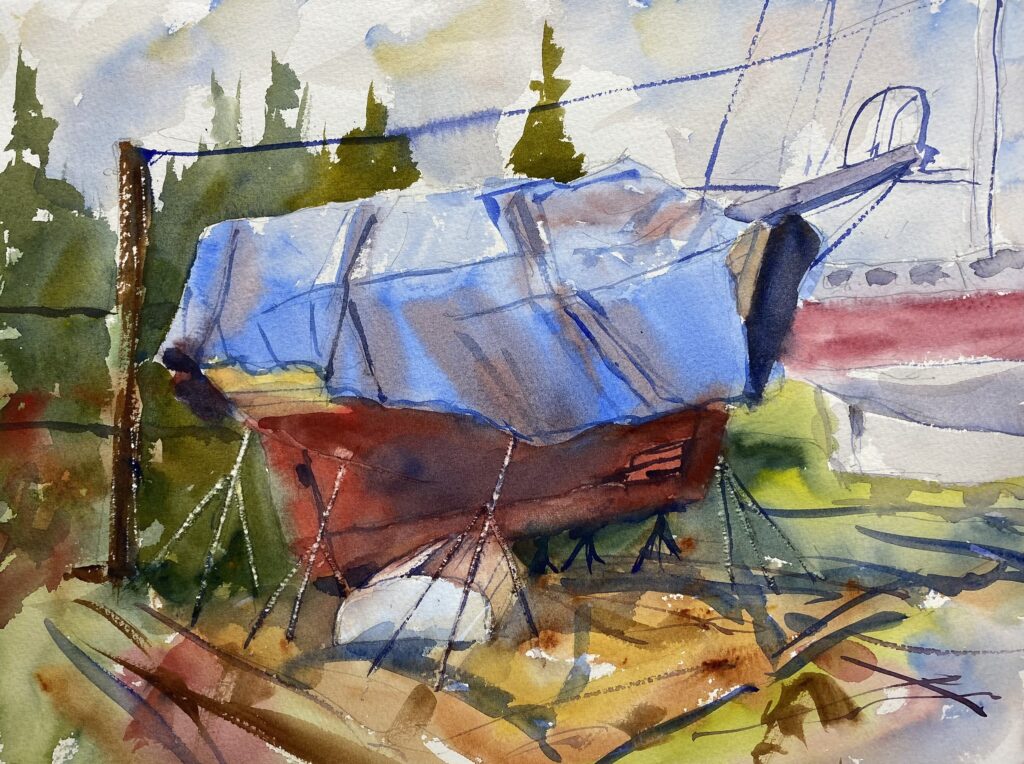
An old wooden boat in a boatyard covered with a blue tarp
Under wraps

You know how modern life is so restricted? “No Trespassing”; ‘Keep Out”; “Do Not Enter”. It’s the fortress mentality everywhere you go: electronic gates, high fences, security cameras, insurance regulations. Where’s a painter gonna paint?

But yesterday I found a refreshing exception. I went to the South Park community of Seattle with other plein air painters from Northwest Watercolor Society. South Park is an older residential neighborhood right next to the rust belt industrial zone of the Duwamish Waterway. There are bridges, cranes, marinas, old barges, aging hulks, tugboats. Everything a painter wants, but most of it is locked up behind chain-link security.

As it happened, I stumbled into a boatyard of sorts. In a two block area, boats were parked chockablock together with all kinds of marine debris in between. It was completely open. No fences, no barriers — a painter’s paradise. It’s too good to be true, I thought. I’ll probably be kicked out as soon as they find me.

I poked my head into the dark interior of a sheet metal shed and found two weatherbeaten characters sipping coffee amid a bewildering assortment of cables, wrenches, cutting torches, welding helmets, and oversize clamps. One of these yard birds had a beard down to his belly button. The other wore a pair of comically wide shorts. I said timidly, “I’m a watercolor painter. Do you think it would be all right if I made a watercolor painting of your boats?”

Mr. Longbeard chuckled and said, “You can paint your picture anywhere you want. Just don’t let the forklift run over you.”

As I backed out of their den, I realized that these fellows probably have a steady stream of painters coming through their rusting paradise, and I was just one more. What a breath of fresh air! I set up my easel and tackled my subject, a neglected old wooden boat with a tarp over it. I thought to myself, if this isn’t a plein air painter’s heaven, I don’t know what is.

No barriers Read More »

How to get into a show

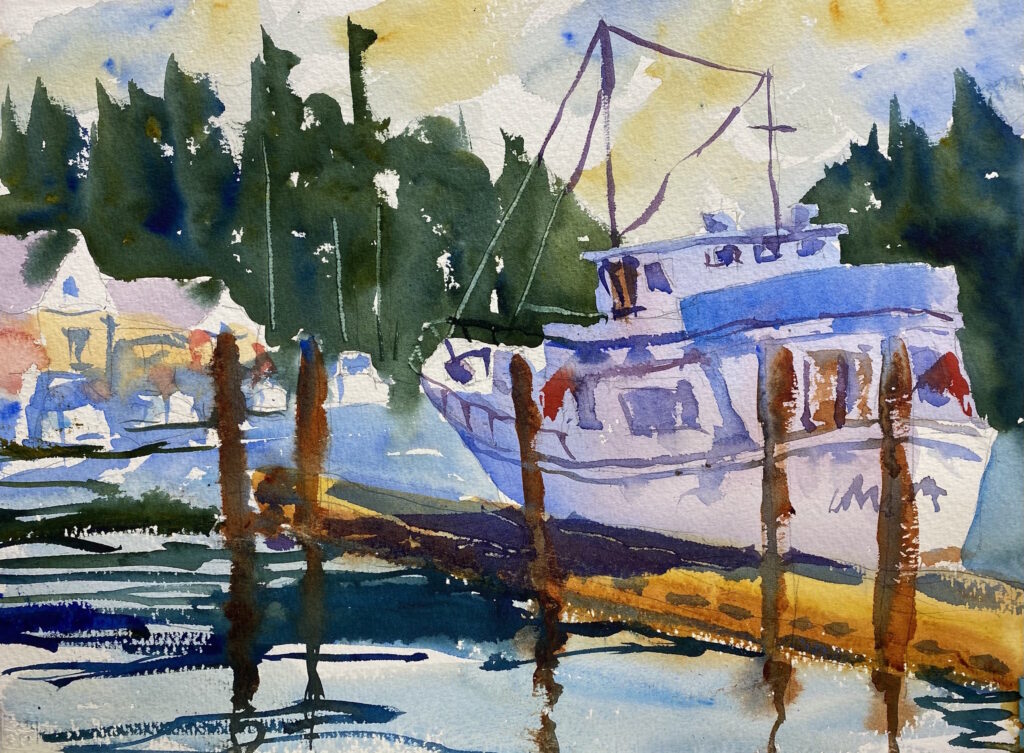
Two fishing boats at a dock in Seattle on a misty day
Boats at Fishermen’s Terminal in Seattle

One of my goals is to get my watercolors into juried shows. I like the prestige of the shows and the increased visibility for my paintings. This means submitting my work in the form of a digital image so the judge of the show can make a decision to accept or reject it.

The first thing is to select which paintings I want to enter. I read carefully the prospectus for each show which details the requirements for acceptance. Then I choose the paintings that I think will be a good match. I make sure the digital images are the right size, then I upload them to the website for the show, making sure I meet the deadline. It’s a lot of work.

The deadline for the Little Gems show at Scott Milo Gallery in Anacortes was yesterday, so I spent a good deal of time preparing for it last week. The maximum size for this show is 11×15 inches. Most of my paintings are slightly larger than that, so I needed to paint some smaller images.

I liked the painting (above) of two fishing boats at Fishermen’s Terminal in Seattle because it was loose and free, but it needed some work. I tried painting it a second time, but the result wasn’t as fresh. So I touched up the original painting by toning down the white of the pilothouses in the reflections and sent it in.

Two skiffs at a dock in a remote bay in the Pacific Northwest
The docks at Dabob Bay

For my second painting, I chose this scene at the docks of Rock Point Oyster Company in Dabob Bay. I painted this scene four times before I was satisfied with it. Each time I painted it, it got a little better.

An oyster dock in South Bend, WA.
The dock at South Bend, WA

I had to touch up this painting also before I sent it in. The reflection under the dock was tentative, and left too many white spaces. So I darkened it and let it blend into the paint on its lower edge. I also added some birds.

Will my paintings get into the show? The gallery will notify painters of their acceptance or rejection on June 15. I’ve had a few paintings accepted into this show in previous years, so I’m hopeful one of these paintings might make it. But it all depends on the judge.

Most of the paintings in the show will be oil or acrylic paintings, so perhaps my watercolors will be looked on favorably. Or maybe not. Most of the paintings will be quite realistic and detailed, so perhaps my loose, impressionistic style will be an advantage. Or maybe not. You never know.

One thing’s for sure. The attraction of getting into a show is a great stimulus for making better paintings, and it spurs me on.

How to get into a show Read More »

Columbia River Gorge Plein Air

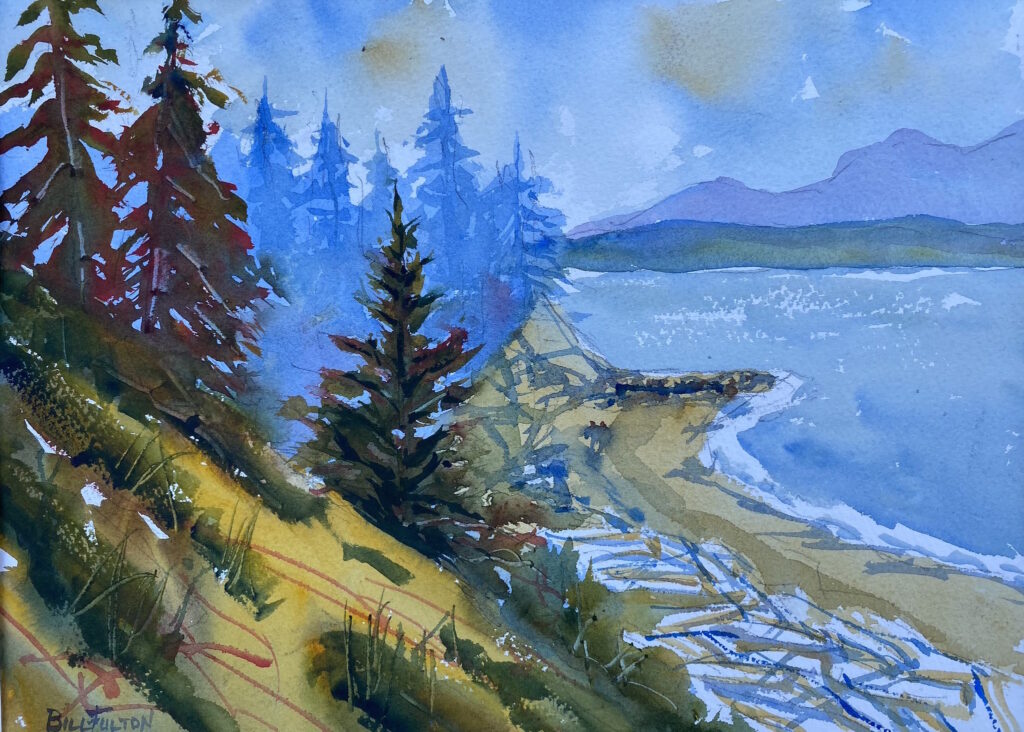
A watercolor painting of the Columbia River Gorge
The Columbia River from Cape Horn Overlook

I spent the last week at Pacific Northwest Plein Air, a painting competition in the Columbia Gorge. I was one of forty artists from all over the country who converged to paint outdoors for four days and show our paintings at the end of the week. The sponsor is the Maryhill Museum of Art near The Dalles, Oregon, where our paintings will hang for a month.

A watercolor painting of a watercolor artist at his easel
Guy

My son, Guy, came with me to be my driver and also to paint along with me. He’s learning to paint watercolors and it’s fun to watch his progress. We stayed with my sister-in-law, Margo, at her house in Stevenson, Washington. I don’t know what I would have done without her hospitality.

I painted ten watercolors over four days. I felt that four of them were good enough to enter into the Museum show. I was happy that I had the energy to paint all day for four days and still be ready for more.

I think my big learning was how to jump into a painting and get it started. Eric Wiegardt says, “Make your first brush stroke be bold.” So I learned to use a big brush for the first stroke and be confident. From then on, the painting flows more easily.

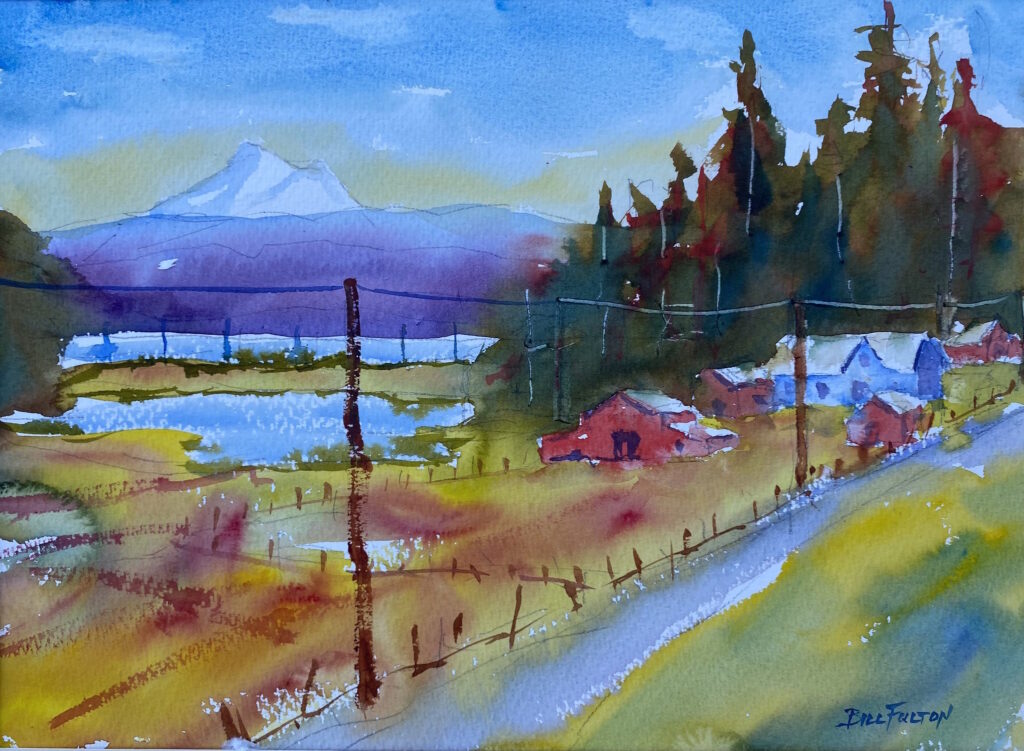
The first day was windy, a common condition in the Columbia River Gorge. After checking in with the other artists, we drove to Glenwood, a rural area tucked right beneath the bulk of Mt. Adams. It was breezy, but manageable. We painted the barns of a ranch with the mountain towering above. One of my two paintings was not bad.

A watercolor painting of Mt. Hood and barns
Mt. Adams with barns near Glenwood

The next day was cloudy but, thankfully, not windy. We drove to the Cape Horn Overlook and hiked about fifteen minutes to a rustic overlook. We painted the long stretch of the Columbia River to the East, with clouds hovering over the ridges. Then we drove to another overlook right on Highway 14 and made another painting. This time I was happy with my big washes. You can find the painting at the top of this post.

To end the day we drove to the Portland Women’s Forum on the Oregon side of the river and painted Vista House, also known as Crown Point, and the river beyond. This is an iconic view that many painters and photographers try to capture, but my values got too dark, and I couldn’t lighten them up. Next time!

On Wednesday it was clear and windless. We drove to Ruthton Park near Hood River where there is a lovely view of the Gorge to the West. I painted a panoramic view but I got a little too detailed in the foreground.

Then we drove to Odell, South of Hood River, and I painted a lovely old Victorian church. I loved the shadows on the church walls, but I muddied them up in my painting. Then I moved to the Pine Grove Cemetery right nearby and painted a view of Mt. Hood hovering over the apple orchards. 

On Thursday we drove to Dalles Mountain Ranch, West of The Dalles. The old barns and buildings of this old cattle ranch have been preserved in a State Park. I’ve painted this several times before, so I felt comfortable painting in a larger format, 15 by 20 inches. This was probably my best painting.

A watercolor painting of the barns at Dalles Mountain Ranch
Dalles Mountain Ranch

In the afternoon we moved across the river to The Dalles where we found an Indian fishing platform on the edge of the river. I enjoyed painting the rocks and the water beneath the platform, and I added a figure on the platform from my imagination. This was probably my most fun painting of the week.

A watercolor painting of a Yakima fishing platform
Yakima fishing platform

By 4:00 we were at the Maryhill Museum of Art with the other artists to turn in our paintings. There was a buzz of excitement as all the artists milled around sharing stories of the week and peeking at each other’s paintings. I felt privileged to be in the company of such talented artists. 

I took Friday off to rest, including a blissful two hour map in the afternoon. Four days of nonstop painting had tired me out. On Saturday I drove a short ways from Margo’s house to the Camas Patch. This is an isolated patch of the rare Camas flower that is protected by the Friends of the Gorge. I made a watercolor just for fun. 

A watercolor painting of three men at an art exhibit
With artist friends at the reception

In the evening we drove to Maryhill Museum, about an hour and fifteen minute drive, to attend the opening reception of the exhibition. It was packed with patrons and artists, and I had a great time mingling with people, commenting on others’ art and discussing my paintings.  A very rewarding evening, and a great conclusion to the week.

Columbia River Gorge Plein Air Read More »
Painting in the flow

Church at Naselle, WA

I felt like I was “in the flow” when I painted this watercolor. I began by painting a loose blue outline, then I used my big brush to lay in wet washes of red and purple on the roof and the sides of the church. As they began to flow into one another and create interesting blends, I kept using my brush to add more washes. It felt like it was a dance. Everything came together without effort.

After I let it dry, I added the figures and the background. You can see that they’re more forced and awkward. But I’m happy with the overall looseness of this painting.

I made this watercolor from a photo I took at Nasalle, WA.

Painting in the flow Read More »
Dances with daffodils

watercolor painting of two vases of daffodils
My second attempt

— “And then my heart with pleasure fills/ and dances with the daffodils.”

— William Wordsworth, “I wandered lonely as a cloud”

For our weekly class, our teacher Eric Wiegardt painted a demo of a bouquet of daffodils. I went back later and viewed the recording of the demo, painting step by step with the recording. My first attempt was labored and tight (see below), but my second attempt (above) was much better. The bouquet on the left is loosely defined, just a suggestion of daffodils. But the bouquet on the right has one daffodil, a white one, that stands out to define daffodils. Pretty happy with this one.

Eric says that he tries to stay abstract as long as possible. Make flower shapes but don’t define them right away. Let the flower washes bleed into one another and add some other color. Then add the dark shapes of greenery and begin to define one or two flowers by outlining them slightly. Finish with some soft background washes and add some detail using the thin sword striper brush.

Here’s my first clumsy attempt:

watercolor painting of two vases of daffodils
My first attempt

Dances with daffodils Read More »
Eric Wiegardt Workshop Review

Watercolor painting of a bouquet of roses
My painting of a bouquet of roses

For four intense days last week I painted a slew of watercolors in a workshop by Eric Wiegardt. The workshop took place in Long Beach, WA, where the weather outside the conference room was constant rain and wind. That just helped us concentrate on the demos and our paintings.

Each morning and afternoon Eric painted a demonstration painting. Then all sixteen of us students tried to copy his work. By the second day, all of us were laughing together as we flailed around with our brushes.

The first day Eric painted a marsh with trees behind it. A good design, he says, requires us to simplify what we see. Starting with a value study using a heavy pencil, he demonstrated how the shapes should be interlocking pieces. He advises that a painting should need no more than three values; five at the most. This helps catch the eye at a distance and draw it to the painting. He often starts his painting with the middle values because that’s where most of the color mixing can be done. It’s easier to judge how dark the dark areas should be after your mid-values are in. It’s also easier to adjust the sky colors to the rest of the painting if it goes in last. His painting (below) was full of light and energy.

Watercolor painting of a marsh
Eric’s demo

When I tried the same scene, my painting lacked the vibrancy and interest of Eric’s. But I got the general idea.

Watercolor painting of a marsh
My attempt to copy Eric’s painting

On the second day, Eric painted a scene from Beard’s Hollow in the nearby Cape Disappointment State Park. This time he started with the dark colors first. That way your darks can be more vibrant, he says, and you can leave flecks of white in them. He paints intuitively, from the right brain, as he moves through the painting process. He tries to not be analytical but just “feels his way through the painting”. When he gets near the end, he will sense some hesitation and he says that’s the sign that he’s slipping into his analytical left brain and it’s time to stop. He comes back later to see if it needs more work.

The bluffs above the beach overlooked a small creek flowing into the ocean. I liked his addition of stylized brush strokes in the beach sand.

Watercolor painting of cliffs above the sea and sand on the shore
My painting

On the third day Eric painted a bouquet of flowers. He wet the paper slightly and used a big brush to block in the general flower shapes, allowing the colors and shapes to run together. Later he came in with dark colors and details to provide definition to the flowers. Eric says, “Keep it abstract as long as possible.” In other words, don’t be too quick to put the details in. Concentrate on the large abstract shapes first, then add details near the end.

Watercolor painting of a bouquet of roses
Eric’s bouquet

I was pretty happy with my floral painting. I borrowed a very large mop brush from Eric and used it to lay in some big juicy flower shapes. Eric helped me by suggesting that I remember to add warm greens to the foliage. (You can see my painting of the bouquet at the top of this post)

On Friday, our last day, Eric painted a street scene from a photo he took in Honfleur, France, while leading a workshop there. Again he started with large, flowing abstract shapes like the buildings, the boat shapes, and the background behind the people. He vaguely painted in figure shapes allowing the colors to run between them. Only at the end did he carve out the figures, leaving them largely undefined. This gives a feeling of movement in a busy street scene.

Watercolor painting of a street scene with people walking
Eric’s street scene

I followed suit, but the background behind my figures got pretty muddy. Still, I like the general affect.

Watercolor painting of a street scene with people walking
My street scene

Overall, the workshop was very stimulating for me. I especially enjoyed the camaraderie of the group, and our conversations over lunch at a nearby restaurant. But after four days of intense concentration on painting, I was ready to come home and sleep in my own bed.

Eric Wiegardt Workshop Review Read More »
Ron Stocke Workshop Review

Watercolor painting of campers around a campfire underneath tall fir trees
My copy of Ron’s demo painting

Ron Stocke is one of the premier watercolor artists I admire, so when I got a chance to register for his two day workshop at Cole Gallery in Edmonds, I signed right up. Ron’s style is loose and impressionistic, with glowing colors and beautifully blended washes.

Ron, who is in his fifties, has painted since childhood. He has an architectural background and loves to paint buildings and cityscapes. He paints with layers of washes. In the first wash he paints in the background sky, distant objects, and foreground. He lets this dry, then he paints the middle ground with its darker values. Then he paints the area of dominance with the dark details, and lastly adds the finishing touches.

He connects the objects of the painting so that there are many soft edges , and he uses light and shadow with dramatic effects. I especially like the way he combines colors on the paper and often adds water to make the pigments flow and blend.

On the first day, about twelve students and Ron met in the basement of Cole Gallery, a rather cozy space. Ron painted a demo of a campfire in the forest at night (below). He painted the first wash, then he let us try it. Then he painted the second wash, explaining as he painted, and we went back to our easels to copy him. Same with the third wash and the details.

I was pretty pleased with my effort. It’s pretty easy when everything has been decided for you and you have a finished painting to copy. All you have to do is replicate what the teacher has painted. I learned a lot watching Ron at the easel as he mixed his washes in the palette and loaded his brush with paint. I was impressed with Ron’s brushes, especially the DaVinci Maestro #12 and #14 brushes. They hold a lot of water and have a beautifully pointed tip (they’re also very expensive!).

Ron Stocke campfire demo

Later in the afternoon, he painted the first two washes of a pond with ducks on it. I think we were all getting tired, so he wrapped it up before we got a chance to paint.

The second day of the workshop was a Sunday, and I felt strange not preaching a sermon in church. My agreement with the church is that I have four Sundays a year off, but still it felt odd. We started earlier so that we could leave in time to watch the Super Bowl. Frankly, I don’t care whose billionaire owner with a bunch of high-paid gladiators beats the other owners’ high-paid gladiators, so it was all the same to me.

Ron painted a beautiful scene of a plaza somewhere in Europe. He painted the first two washes, explaining as he painted, and then we tried it. I wasn’t as able to replicate his washes, probably because I was tired from the first day, but I learned a lot. Here is my effort, with his beautiful painting below mine.

Watercolor painting of campers around a campfire underneath tall fir trees
My copy of Ron’s demo
Watercolor painting of a plaza in Europe with pedestrians and a bicyclist
Ron Stocke plaza demo

Near the end of the workshop, Ron showed us how he paints human figures and cars. He showed us his sketchbook, in which he works out the composition of his paintings. Some of his sketches are worthy of being framed.

Watercolor sketches of figures and cars
My copies of Ron’s sketches

I feel I learned a lot from Ron’s workshop. He’s very encouraging, going from person to person to offer suggestions on their level. He’s very positive and an enthusiastic champion of watercolor painting. I think my personal style of painting is a little looser and more colorful, but I appreciated learning from Ron.

Ron Stocke Workshop Review Read More »